
In the rapidly evolving food industry, manufacturers are under constant pressure to create products that meet consumer demand for clean label, natural, and functional ingredients. Organic konjac flour, derived from the root of the konjac plant, has emerged as a versatile solution for these challenges.
Natural Thickening Power
Organic konjac flour is a powerful thickener due to its high content of glucomannan, a water-soluble dietary fiber. Even in small amounts, it can dramatically improve the viscosity of sauces, dressings, soups, and plant-based dairy alternatives, reducing the need for artificial thickeners.
Glucomannan is a high-molecular-weight polysaccharide built mainly from mannose with a smaller share of glucose units, and food-grade konjac flour typically contains 60–80% of it. Because the molecule is long and highly branched along its backbone, it binds large amounts of water and swells into a viscous, slippery dispersion. A 1% dispersion in water can reach viscosities in the tens of thousands of mPa·s, which is why konjac is usually dosed at 0.1–0.5% of the finished product rather than at starch-like levels of several percent.
Hydration is fast, and that is both the advantage and the practical problem. Konjac powder wets quickly and tends to form lumps if it meets water on its own. Pre-blend it with the other dry ingredients, or disperse it in a small amount of oil, before it touches the aqueous phase, then allow a few minutes of shear for full hydration.
Clean Label Advantage
Consumers are increasingly scrutinizing ingredient lists, preferring products with recognizable, natural components. Using organic konjac flour allows food manufacturers to label products as naturally thickened and fiber-enriched, enhancing brand transparency and consumer trust.
On a label, konjac appears as konjac flour or konjac glucomannan rather than as a modified starch or a synthetic gum, and it counts toward the dietary fiber figure on the nutrition panel. It is also considered a food ingredient rather than an additive, so it does not need an E-number in the European Union and it does not carry the allergen labelling burden of soy or egg based binders. That combination is what makes it attractive for short, readable ingredient declarations.
Stability and Texture Enhancement
One of the key benefits of organic konjac flour is its ability to improve texture and stability. It forms a smooth, gel-like consistency that maintains its structure during processing and storage, making it ideal for low-calorie, gluten-free, and plant-based formulations.
Glucomannan solutions tolerate typical pasteurisation and retort temperatures, and they hold viscosity across a wide pH band, which is useful in acidified dressings and fruit-based sauces. Konjac also cooperates with other hydrocolloids: with xanthan gum it forms an elastic, thermoreversible gel, and with kappa carrageenan it produces a firmer, more cohesive gel that resists syneresis better than konjac alone. In freeze-thaw cycling, konjac-only gels can release water, so formulators usually pair it with a small amount of another gum when a product will be frozen and thawed.
Versatility Across Applications
From bakery fillings to beverages, sauces, and meat alternatives, organic konjac flour adapts to diverse applications. Its neutral taste and excellent water-holding capacity make it a practical choice for product innovation and reformulation.
- Sauces, gravies, and dressings where a clean-label body is needed at low dosage
- Plant-based yoghurt and dessert bases, where it lifts texture without dairy solids
- Bakery fillings and fruit preparations that must hold shape at room temperature
- Low-calorie and keto products, including konjac pasta and rice analogues
- Meat and fish analogues, where it binds water and improves sliceability
Sustainable and Certified Organic
As a naturally derived ingredient, organic konjac flour aligns with sustainability goals and organic certifications. Partnering with trusted suppliers ensures consistent quality and reliable supply for large-scale manufacturing.
Konjac is a perennial crop that grows well under shade and needs comparatively little input, so organic cultivation is realistic rather than aspirational. What a buyer should verify is the paperwork behind the claim: an organic certificate that names the actual processing site, a non-GMO statement, and a batch certificate of analysis that reports glucomannan content, viscosity, moisture, ash, and particle size. Those four numbers are what keep viscosity consistent from one delivery to the next.
How It Compares With Other Thickeners
Against corn starch, konjac thickens at roughly a tenth of the dose but does not build the same opaque, floury body, and it will not tolerate a long boil the way a modified starch does. Against xanthan gum, it gives a softer, more slippery texture that consumers often describe as less gummy. Against gelatin, it is plant-based and heat-stable rather than melt-in-the-mouth. For a wider look at how konjac performs in dairy-free and plant-based systems, see how organic konjac flour enhances texture and stability in plant-based foods.
Choosing Organic Konjac Flour for Your Formulation
For food manufacturers aiming to meet modern consumer expectations, organic konjac flour is not just a thickener—it is a strategic ingredient that supports clean label, texture enhancement, and nutritional benefits. By integrating it into your formulations, your brand can achieve functional excellence while staying true to natural and organic principles.
If you are benchmarking suppliers, the practical questions are simple: what is the glucomannan content, what viscosity does a 1% dispersion reach, how fine is the powder, and how stable is that viscosity between lots? The guide to organic konjac flour as a clean-label thickener walks through the same checklist from the buyer’s side.
About Our Organic Konjac Flour
Our organic konjac flour is milled from organically cultivated konjac root and supplied as a fine, off-white powder with a neutral taste and no residual odour. It is certified organic and non-GMO, free of the major allergens, and suitable for vegan, gluten-free, and low-calorie formulations. BIOSTARCH supplies it in bulk to sauce, dressing, plant-based dairy, bakery, and meat-alternative producers, with specification sheets, certificates of analysis, and organic documentation available for each lot. For purified grades, we also offer glucomannan where a higher active content is required.
Recommended Products
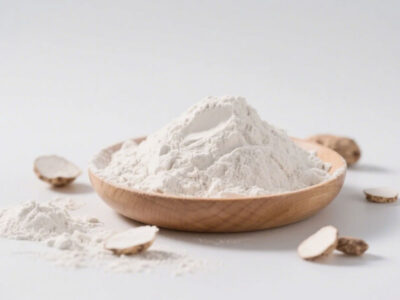
Konjac Flour
Konjac flour is a thickening and gelling agent milled from konjac tuber. Its high…
Related Posts


