
In today’s food industry, the demand for ingredients that offer superior functionality without compromising on clean labels or natural sourcing is paramount. While many starches exist, organic potato starch is increasingly standing out as a preferred choice for food manufacturers and home cooks alike. Derived simply from potatoes, this versatile carbohydrate offers exceptional thickening, gelling, and texturizing properties, making it an indispensable tool for a wide array of applications.
Why Organic Potato Starch Behaves Differently
Potato starch is not interchangeable with other starches, and the reason is in the tuber rather than in the process. Potato starch granules are larger and more irregular than corn starch granules, which changes how much water they take up, how they swell under heat, and how they behave when a product is sheared. These are the properties a formulator is actually buying when the specification says potato starch, and they are also why a potato starch that behaves differently in production is usually a granulation or a source question rather than a quality question.
| Property | Organic potato starch | Corn starch | Tapioca starch |
|---|---|---|---|
| Granule size | Larger and more irregular | Smaller and more uniform | Medium, relatively uniform |
| Swelling and thickening | High swelling, strong thickening | Moderate thickening | Clear and smooth thickening |
| Shear behaviour | Stable under moderate shear | Stable | Can thin noticeably when sheared |
| Texture contribution | Short, smooth, slightly creamy | Neutral, slightly powdery | Clear and glossy |
| Typical use | Bakery, coated products, thick sauces, extruded snacks | Bakery, dry blends, filler | Sauces, fillings, beverages |
Two practical consequences follow. First, in a baked product, potato starch gives a short and tender crumb rather than the slightly powdery bite of corn starch, which is why it is preferred in crackers, wafers and coated biscuits. Second, in a heated sauce or a filled product, its swelling behaviour means less of it is needed to reach the target consistency, and the resulting texture stays stable through a shear step such as pumping or homogenising, where a clear starch can lose body.
Organic Potato Starch Specifications to Compare
Because potato starch is a natural product, its analytical values move with the crop and the processing, and two grades of the same product can differ. These are the parameters that most often separate one quotation from another, and the ones worth fixing on the order rather than leaving open.
| Parameter | What to specify | Why it matters |
|---|---|---|
| Starch content | Minimum level, confirmed per batch | Sets the thickening and binding performance of the delivered material |
| Moisture | Upper limit | Water carried into the dough or the batter, and how stable the bags stay in storage |
| Granulation | Coarse, medium or fine, stated on the order | Dispersion behaviour, whether the starch hydrates evenly or sieves out |
| Colour | White to off-white, with a defined range | Visible finish in pale crackers, coatings and extruded products |
| pH | Typical range | Processing behaviour and the shelf life of the finished product |
| Ash and protein | Low, with limits | Residue from the extraction and washing steps, a proxy for purification quality |
| Organic certification | Valid for the batch, with a certificate number | The claim can only be carried if the certification follows the lot |
BIOSTARCH supplies organic potato starch in powder grades with the granulation stated per order, and the accompanying organic cornstarch and organic rice starch lines are the natural comparison when a formulation is looking for a different swelling or texture profile rather than simply a different origin.
Applications in Food Manufacturing
The applications that respond most strongly to potato starch are the ones where texture and stability matter more than cost per kilo. In crackers and wafers it produces a tender, short crumb and a clean snap. In coated and filled biscuits it binds the filling without a gummy mouthfeel, because the swelling is gradual rather than sudden. In thick sauces, gravies and spoonable dressings it reaches body with a short, clean texture and holds it through processing.
It is also the standard choice in extruded snacks, where the starch has to expand under heat and hold its structure, and in bakery coatings and breadcrumbs for fried products, where a low fat absorption and a stable crumb matter. For a manufacturer working across several of these categories, the practical approach is to fix the specification once, including granulation and the certificate requirements, and to order against that specification rather than against a product name.
For the wider picture, our complete guide to organic starches compares the main starch types side by side, and the overview of starches in industrial applications sets out where each type is used at production scale.
Are you ready to explore why organic potato starch is becoming a go-to solution for enhancing texture and stability in wholesome, delicious products?
What Makes Potato Starch So Functional? The Science of Superior Texture
Potato starch is a fine, white powder extracted from potatoes. Its unique molecular structure, composed of relatively large granules, gives it distinct advantages in food applications:
- Exceptional Thickening Power: It’s renowned for its high thickening ability, often requiring less quantity than other starches to achieve the desired viscosity. This can lead to cost savings and a cleaner product profile.
- Neutral Flavor Profile: Unlike some starches that can impart a starchy or off-flavor, potato starch is remarkably neutral. This ensures it won’t interfere with the intended taste of your food, making it ideal for delicate flavors.
- Excellent Clarity: When cooked, it produces a clear, glossy finish, which is highly desirable in sauces, gravies, pie fillings, and fruit preparations, enhancing visual appeal.
- Superior Freeze-Thaw Stability: It holds up well under freezing and thawing cycles, preventing syneresis (liquid separation) in frozen desserts, ready meals, and sauces, maintaining product quality over time.
- Pleasant Mouthfeel: It contributes to a smooth, creamy texture and a tender bite, enhancing the overall sensory experience of foods.
Organic: The Gold Standard for Purity and Trust
For an ingredient as fundamental as starch, opting for “organic” provides crucial assurances for both consumers and brands:
- Clean Sourcing: Organic certification guarantees that the potatoes used are cultivated without synthetic pesticides, herbicides, or chemical fertilizers. This commitment to pure agriculture ensures that no unwanted chemical residues end up in your final product.
- Non-GMO Assurance: Organic potato starch is inherently non-GMO, aligning perfectly with consumer preferences for natural and unmodified ingredients.
- Environmentally Responsible: Organic farming practices promote healthier soil, conserve water, and support biodiversity, making it an environmentally conscious and sustainable choice.
- Clean Label Credibility: “Organic Potato Starch” is a clear, simple ingredient statement that resonates with consumers seeking transparent and understandable food labels.
Versatile Applications: From Pantry Staple to Industrial Essential
The functional benefits and clean label status of organic potato starch make it incredibly versatile across a multitude of applications:
- Culinary Arts at Home:
- Thickening Agent: Perfect for gravies, sauces, stews, and soups, providing smooth, lump-free consistency.
- Baking Aid: Use it in gluten-free baking to provide structure, moisture, and a tender crumb in cakes, cookies, and breads.
- Crispy Coatings: Achieve extra crispiness in fried foods or roasted vegetables.
- Food Manufacturing & Innovation:
- Clean-Label Product Development: An ideal ingredient for creating natural, additive-free versions of everyday foods.
- Dairy & Plant-Based Alternatives: Provides excellent texture and stability in yogurts, puddings, and non-dairy beverages.
- Confectionery: Used in gummies, jellies, and other confections for desired texture and mouthfeel.
- Meat Alternatives: Contributes to binding and texture in plant-based meat products.
So, whether you’re a home chef perfecting your gravies or a product developer crafting the next clean-label sensation, is organic potato starch your new ingredient solution? Embrace its natural power for superior texture, stability, and purity.
Q: Is organic potato starch the same as potato starch flour?
A: Yes, the two names refer to the same ingredient. Potato starch flour and potato starch powder are the milled starch of the potato with the cell material removed. What differs between grades is the granulation, the moisture level and the certification, and all three should be stated on the order.
Q: How does potato starch differ from cornstarch in baking?
A: Potato starch gives a shorter, more tender crumb and a cleaner snap, while cornstarch is more neutral and slightly powdery on the palate. Potato starch also swells to a greater degree, which is why it is used in crackers, wafers and coated biscuits where the bite has to stay crisp and the filling has to bind without becoming gummy.
Q: How much organic potato starch should I use as a thickener?
A: The right rate depends on the application and on the granulation, and it is always lower than for cornstarch because the swelling behaviour is stronger. In a sauce the usual starting point is a small percentage of the liquid phase, adjusted in the trial kitchen, and in a filled or coated product the level is set by the structure the finished item has to hold.
Q: Is organic potato starch suitable for gluten-free products?
A: Potato starch is naturally gluten free, and the separated starch carries no gluten proteins, which makes it a standard ingredient in gluten-free bakery and coating systems. The finished product still needs to be controlled for cross-contamination on the line, and the documentation of the batch is what supports the claim in the file.
Q: How is organic potato starch supplied in bulk?
A: In powder grades delivered as bags on pallets or in IBC totes, with the granulation and the packing confirmed before production so the material is not transferred repeatedly. Each lot is issued with a certificate of analysis, an organic certificate, a specification sheet and a safety data sheet.
Recommended Products
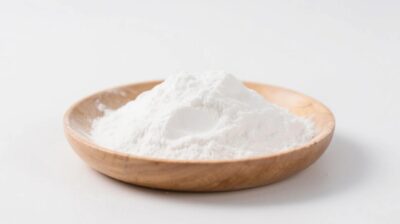
Organic Potato Starch Powder
Organic potato starch powder is a certified-organic native starch from non-GMO potatoes. With high…
Rice Starch
Organic rice starch is a certified-organic native starch with very fine granules and a…
Related Posts


