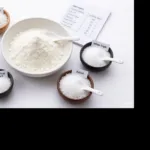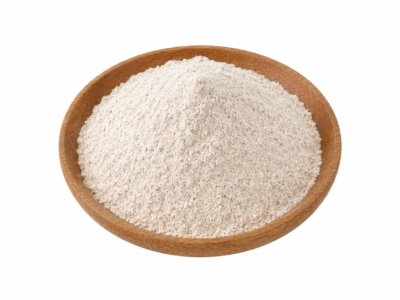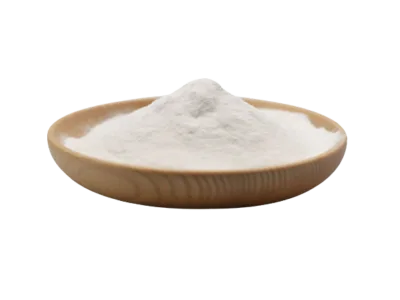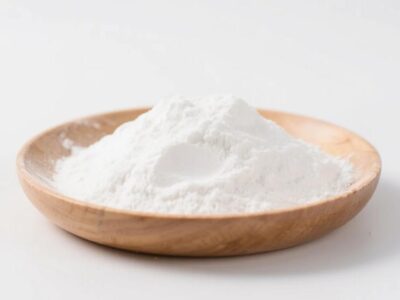
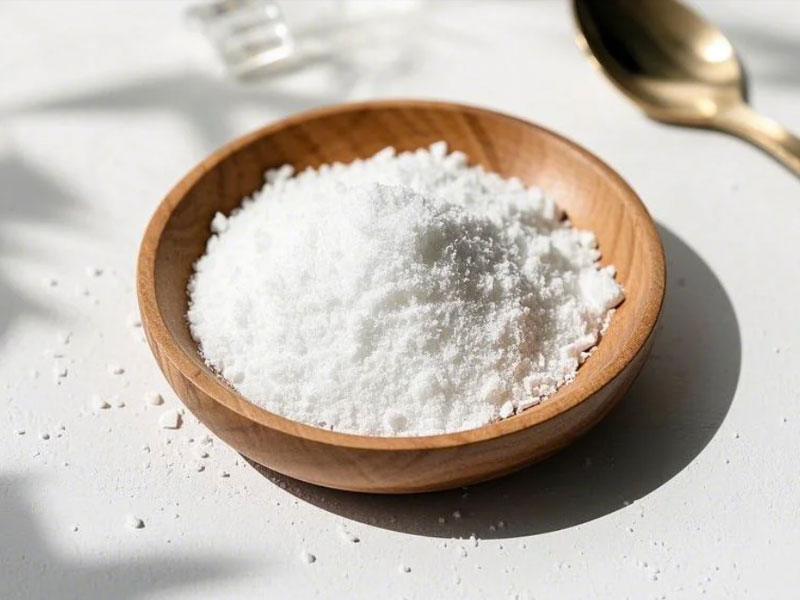
We supply allulose sweetener in two food-grade forms – an ultra-fine crystalline powder and a liquid syrup – for food and beverage manufacturers who need a natural, low-calorie replacement for sugar that still behaves like sugar on the line.
Allulose tastes, textures and performs like sucrose, but it contributes almost no calories and does not raise blood glucose. Our material is enzymatically derived from corn and other non-GMO feedstocks under strict quality controls, and each lot is released against the purity, safety and sustainability requirements of the markets we ship to.
What Is Allulose Sweetener?
Allulose (D-psicose) is a rare monosaccharide that occurs naturally in small quantities in dried fruits such as figs and raisins. The commercial material is produced enzymatically from corn and other non-GMO feedstocks.
It delivers approximately 70% of the sweetness of table sugar at only 0.2–0.4 calories per gram. Because it is not significantly metabolized for energy, it suits ketogenic diets, low-glycemic formulations and clean-label products.
Both forms share that sweetness and that negligible glycemic impact. The difference between them is physical, and it decides which one a given line should order.
Technical Specifications
The specification is set on allulose content, moisture, pH, specific rotation and caloric value, with heavy-metal and microbiological limits released for every batch.
| Parameter | Allulose Powder | Allulose Syrup (Typical) |
|---|---|---|
| Appearance | White crystalline powder | Clear to light amber viscous liquid |
| Allulose Content (Assay) | ≥99.0% (dry basis) | 70–85% solids |
| Moisture Content | ≤1.0% | 15–30% |
| pH (10% aqueous solution) | 5.0 – 7.0 | 5.5 – 6.5 |
| Specific Rotation | –3.0° to –5.0° | –3.0° to –5.0° |
| Caloric Value | 0.2 – 0.4 kcal/g | 0.3 – 0.5 kcal/g |
| Solubility | Fully soluble in water | Miscible with water |
| Shelf Life | 24 months (stored sealed, cool, dry) | 18 months (stored sealed, cool, dry) |
| Heavy Metals (Maximum Limits) | ||
| – Lead (Pb) | ≤0.1 mg/kg | ≤0.1 mg/kg |
| – Arsenic (As) | ≤0.1 mg/kg | ≤0.1 mg/kg |
| – Cadmium (Cd) | ≤0.05 mg/kg | ≤0.05 mg/kg |
| – Mercury (Hg) | ≤0.01 mg/kg | ≤0.01 mg/kg |
| Microbiological Criteria | ||
| – Total Plate Count | ≤1,000 CFU/g | ≤1,000 CFU/g |
| – Yeast & Mold | ≤100 CFU/g | ≤100 CFU/g |
| – Escherichia coli | Absent in 10 g | Absent in 10 g |
| – Salmonella spp. | Absent in 25 g | Absent in 25 g |
| – Listeria monocytogenes | Absent in 25 g | Absent in 25 g |
All batches are tested by third-party laboratories for identity, purity, heavy metals and microbiological criteria, and are released with full traceability from raw material to finished product.
Sourcing, Certification and Regulatory Status
Allulose is a defined single molecule, so the specification travels between markets unchanged. What differs is the regulatory route, not the chemistry.
| Jurisdiction / Standard | Regulatory status | Legal name | Notes |
|---|---|---|---|
| United States | GRAS; FDA raised no questions on GRN No. 400 (D-psicose) | Allulose (D-allulose) | FDA guidance published in October 2020 allows allulose to be excluded from Total Sugars and Added Sugars while remaining part of Total Carbohydrate, with a general factor of 0.4 kcal/g. |
| European Union | Novel-food route under Regulation (EU) 2015/2283; no authorisation in force | D-allulose | EFSA published its novel-food opinion on D-allulose on 5 June 2025; an authorisation decision is pending. |
| Japan | Permitted as a food ingredient | Psicose (allulose) | Regulated through the general food safety framework rather than a novel-food route. |
| China | Approved as a new food ingredient (三新食品) by 国家卫生健康委员会, 2025 | D-阿洛酮糖 (D-Allulose) | 公告号:2025年第4号 |
Outside the jurisdictions above, confirm the local route to market before ordering. Documentation to support your registration file is available with the batch paperwork.
Applications
Allulose carries sweetness without the calories, and it also brings process functions that formulators choose deliberately. The form of supply decides which of those functions is easiest to use.
Allulose Powder
- Dry blends and baking mixes – a fine particle size gives uniform dispersion and consistent sweetness
- Confectionery and tabletop sweeteners – a free-flowing crystalline base with high solubility and excellent thermal stability
- Bakery – enhances browning through the Maillard reaction, improves softness and reduces crystallization
- Nutritional supplements – a palatable carrier in chewables, powders and syrups
Allulose Syrup
- Beverages – clean sweetness in carbonated drinks, teas, functional waters and ready-to-drink formats, without aftertaste
- Dairy alternatives and frozen desserts – stabilizes ice cream texture and boosts mouthfeel in plant-based yogurts and milks
- Sauces and dressings – adds subtle sweetness while improving viscosity and shelf stability
- Humectant systems – improves moisture retention, texture and shelf life in liquid and semi-solid formulations
Format and Grade Selection
Both forms deliver the same sweetness, so the choice is normally a process decision rather than a formulation one.
| Parameter | Allulose Powder | Allulose Syrup |
|---|---|---|
| Best fit by process | Dry blending, weighing and tableting lines | Liquid dosing, pumping and in-line blending |
| Effect on moisture | Adds essentially no water to the mix | Carries water in and improves moisture retention, texture and shelf life |
| How the sweetness is delivered | Fine particle size gives uniform dispersion and consistent sweetness | Dissolves readily and blends evenly into liquid and semi-solid systems |
| Choose it when | The formulation has to stay dry | A pourable sweetener fits the line |
A dry line should take the powder and a wet process should take the syrup. Compare quotations on the basis each specification uses, because the powder is declared on a dry basis and the syrup on a solids basis.
Why Choose Our Allulose Sweetener?
We specialize in high-purity, sustainably sourced allulose tailored to industrial and commercial needs, and we stay with the project from first sample to scale-up, including formulation R&D support and the regulatory documentation your registration file needs.
All batches undergo rigorous third-party testing for identity, purity, heavy metals and microbiological safety. Full traceability from raw material to finished product is maintained under ISO-compliant quality management systems.
Packing
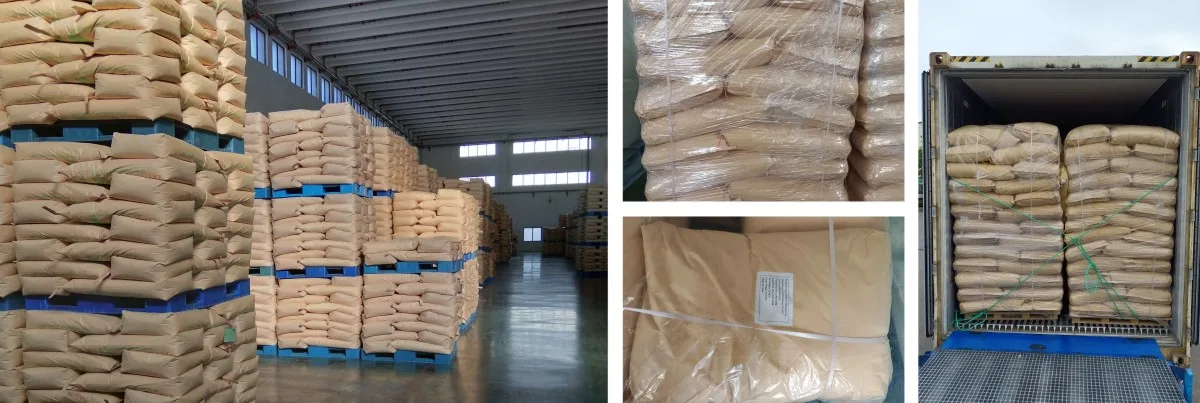
Both forms are supplied in flexible packaging sized to the order, from 1 kg up to 1 MT bulk totes, so pilot lots and bulk production can be delivered on the same specification.
Store sealed in a cool, dry place, away from direct sunlight and moisture.
Also Known As: Names and Synonyms in the Trade
Allulose appears under several other names in specifications, regulatory filings and catalogue listings. The list below covers the ones that turn up most often in enquiries, technical data sheets and customs paperwork.
- D-Psicose – the name used in earlier scientific literature and still carried in supplier catalogues and in the identity tables of some regulatory filings
- D-Allulose – the stereochemically explicit spelling used in FDA GRAS notices and in the EFSA assessment of the ingredient
- D-Ribo-2-hexulose – a carbohydrate-nomenclature synonym listed in FDA GRAS filings and in analytical catalogue entries
- D-Ribo-2-ketohexose – a variant of the same nomenclature name, seen in the same filings and in laboratory reference sheets
- D-Pseudofructose – a catalogue synonym for the same identity
- Rare sugar – the category label applied to allulose in Japanese regulation and in technical writing on the ingredient
- Crystalline allulose – trade shorthand for the solid grade, as opposed to the syrup
- Allulose syrup – trade shorthand for the liquid grade
Different names do not mean different ingredients. Where a specification uses D-psicose, D-allulose or allulose interchangeably, it is referring to the same monosaccharide described in this section.
FAQs
Q: What is the caloric value and sweetness level of Allulose compared to sugar?
A: Allulose provides approximately 0.2-0.4 kcal/g, significantly lower than sucrose (4 kcal/g). Its sweetness is around 70% that of sucrose, so increased usage or blending with high-intensity sweeteners may be needed to match sucrose sweetness.
Q: Is Allulose suitable for keto-friendly and low-glycemic products?
A: Yes, Allulose has a negligible impact on blood glucose and insulin levels, making it highly suitable for both keto-friendly and low-glycemic food and beverage formulations.
Q: Does Allulose have an aftertaste?
A: One of the key advantages of Allulose is its clean taste profile. It generally does not leave the cooling sensation or bitter aftertaste commonly associated with many artificial or high-intensity sweeteners.
Q: Is Allulose considered a sugar alcohol or an artificial sweetener?
A: No, Allulose is classified as a rare sugar or novel sugar, a naturally occurring monosaccharide. It is not a sugar alcohol and is distinct from artificial sweeteners.