
Fructooligosaccharides, known almost universally by their abbreviation FOS, sit at the intersection of several food industry trends: sugar reduction, gut health, clean-label formulation, and organic sourcing. For product developers, they offer a rare combination of functional sweetness and prebiotic fiber in a single ingredient. For procurement teams, understanding the differences between forms, sources, and certifications can mean the difference between a smooth production run and an expensive reformulation. This organic FOS complete guide covers what FOS actually is at the molecular level, how the powder and syrup forms differ in practice, the production methods behind each type, the naming conventions that sometimes confuse buyers, and the criteria that matter most when selecting a supplier.
What Is Organic FOS? (Fructooligosaccharides)
FOS belongs to a class of carbohydrates called fructans — polymers built primarily from fructose units. The chemical structure is straightforward: a chain of fructose molecules linked by beta-(2→1) glycosidic bonds, capped at one end by a glucose unit. The degree of polymerization, or DP, describes how many fructose units are in the chain. For FOS, this DP typically falls between 2 and 10, placing it in the short-chain category of fructans. This short chain length is what distinguishes FOS from longer-chain inulin, which can reach a DP of 60 or more.
The beta-(2→1) linkage is the structural feature that defines FOS functionally. Human digestive enzymes in the stomach and small intestine cannot hydrolyze this bond. As a result, FOS passes through the upper gastrointestinal tract without being absorbed, arriving intact in the colon. There, resident bacteria — particularly Bifidobacteria and certain Lactobacillus species — possess the enzymes needed to break these bonds and ferment the fructose chains. This selective fermentation is the basis for FOS classification as a prebiotic fiber.
The organic designation adds another layer. Organic FOS must come from crops grown under certified organic agricultural standards, meaning no synthetic pesticides, herbicides, or fertilizers were used on the source material. The processing — whether enzymatic conversion or extraction — must also avoid prohibited solvents and processing aids. In practice, organic FOS is most commonly derived from organic sucrose or organic chicory root, with the certification body varying by region of origin and target market.
In terms of sensory properties, FOS carries a clean, mildly sweet taste. Its sweetness intensity ranges from roughly 30 to 50 percent that of sucrose, depending on the specific DP profile and concentration. This moderate sweetness makes it useful as a partial sugar replacer rather than a high-intensity sweetener. The flavor is neutral, without the bitter or metallic aftertaste associated with some alternative sweeteners, and it does not mask or alter other flavors in a formulation.
FOS Powder vs FOS Syrup
FOS is commercially available in two primary physical forms: powder and syrup. While they share the same underlying chemistry, the practical differences between them affect everything from shipping logistics to finished product texture. The table below summarizes the key distinctions.
| Attribute | FOS Powder | FOS Syrup |
|---|---|---|
| Appearance | Fine white to off-white powder, free-flowing | Clear to pale golden viscous liquid |
| Typical Dry Matter | 95–97% | 70–75% |
| Sweetness (vs sucrose) | 30–50% | 30–50% (adjusted for concentration) |
| Solubility | Readily soluble in water, dissolves without heat | Already in solution; miscible with water in any ratio |
| Handling | Requires dry storage, can generate dust during transfer | Pumpable, no dust, requires liquid handling equipment |
| Shelf Life | 24 months under proper conditions | 12–18 months under proper conditions |
| Best Applications | Dry blends, powder supplements, baking mixes, bars, capsules | Beverages, liquid supplements, syrups, sauces, dairy products, confectionery |
FOS powder is the more versatile of the two forms. It integrates easily into dry manufacturing workflows: blending with other powders, filling into capsules, or mixing into doughs and batters. Its long shelf life and stability at ambient temperatures make it practical for global shipping and extended warehousing. The main handling consideration is dust control during transfer and mixing — standard industrial dust collection equipment is sufficient.
FOS syrup offers distinct advantages in liquid applications. Because it arrives as a pre-dissolved concentrate, it eliminates a dissolution step in the manufacturing process. This saves time and energy in beverage production, where FOS syrup can be metered directly into the batch tank. The viscous, golden liquid also contributes body and mouthfeel to finished products, which can be a desirable attribute in dairy drinks, functional shots, and syrup-based formulations. The trade-off is a shorter shelf life compared to the powder form, driven by the higher water activity, and heavier shipping weights per unit of active FOS due to the water content.
For most general-purpose applications, the powder form offers the best balance of flexibility, stability, and cost efficiency. Syrup becomes the preferred choice when the end product is a liquid and skipping the powder dissolution step simplifies the production line.
How Is FOS Made?
FOS can be produced through two fundamentally different routes, and the distinction matters for anyone concerned about organic status, GMO considerations, or specific functional properties.
The first and most widely used commercial method is enzymatic conversion from sucrose. In this process, the enzyme fructosyltransferase is introduced to a concentrated sucrose solution. The enzyme catalyzes a transfructosylation reaction: it cleaves the bond between glucose and fructose in sucrose and transfers the freed fructose unit onto another sucrose molecule, building short fructose chains. As the reaction proceeds, the DP distribution shifts, producing a mixture of 1-kestose (GF2), nystose (GF3), and fructosyl-nystose (GF4), along with some glucose released during the transfer. After the desired DP profile is reached, the enzyme is deactivated, residual glucose and unreacted sucrose are separated, and the FOS fraction is concentrated and dried into powder or adjusted to syrup specifications.
When the starting sucrose is certified organic, the resulting FOS can carry organic certification as well. This is a critical point for procurement: organic sucrose-derived FOS shares the same chemical structure as conventional FOS, but the agricultural practices behind the raw material meet organic standards. Manufacturers sourcing organic FOS should confirm that both the sucrose feedstock and the processing facility hold current organic certification from a recognized body.
The second method is extraction from chicory root. Chicory naturally stores inulin — long-chain fructans — in its taproot. The harvested roots are washed, sliced, and steeped in hot water to extract the inulin. The resulting liquid is purified, and the inulin chains are then partially hydrolyzed — either enzymatically or with mild acid — to shorten them to the FOS DP range of 2 to 10. The shorter chains are separated, concentrated, and dried. Chicory-derived FOS benefits from the plant-based, non-GMO narrative that resonates with many consumers, and organic certification follows the agricultural practices used to grow the chicory.
Both production routes yield FOS with similar prebiotic functionality, though there can be subtle differences in the DP distribution and in the profile of residual sugars. Enzymatically produced FOS from sucrose tends to have a tighter, more controlled DP range because the reaction conditions can be tuned precisely. Chicory-derived FOS may contain trace amounts of longer-chain fructans that are not fully hydrolyzed. For most applications, these differences are not functionally significant, but they can matter in formulations where sugar content labeling or specific fermentation rates are under scrutiny.
Common Names and Aliases
Few ingredients accumulate as many names as FOS, and the overlap between scientific nomenclature, marketing language, and regulatory labeling can create confusion — particularly for buyers who encounter different terms on different supplier documents. Here are the most common aliases and what they actually mean:
Fructooligosaccharides is the full chemical name and the term most often seen on technical data sheets and Certificates of Analysis. It describes the molecular structure precisely: oligosaccharides (short chains of sugars) composed primarily of fructose.
FOS is the standard industry abbreviation and the most practical term for everyday use in procurement, formulation, and quality documentation.
Oligofructose is a term used somewhat interchangeably with FOS, though it more commonly appears in nutrition science literature and on European ingredient declarations. Technically, oligofructose can refer either to short-chain fructans derived from chicory inulin by partial hydrolysis or to sucrose-derived FOS. When reading specifications, the source material tells you which one you are dealing with.
Fructo-oligosaccharides is simply a hyphenated variant of fructooligosaccharides. It appears in some regulatory contexts and on certain product labels, particularly in markets where hyphenated chemical names are the convention. It refers to the same substance.
scFOS or short-chain fructooligosaccharides is a more precise term that emphasizes the DP range. It is sometimes used to distinguish enzymatically synthesized FOS from chicory-derived oligofructose, particularly in scientific publications and patent literature.
The practical takeaway for ingredient buyers is to look past the name on the label and check the specification sheet. Two products labeled “oligofructose” may have different DP profiles, different source materials, and different organic certification status. The spec sheet, not the trade name, tells the real story.
How to Choose the Right Organic FOS
Selecting the right FOS product starts with a clear understanding of what the ingredient needs to do in the finished product and what constraints exist around certification, cost, and supply chain reliability.
Organic certification should be the first checkpoint. Request the organic certificate from the supplier and verify that the certifying body is accredited and recognized in the target market. A USDA NOP certificate covers the U.S. market; an EU organic logo or equivalent covers Europe; many suppliers now carry dual certification for both. Confirm that the scope of the certificate covers the specific FOS product and that the certificate is current — lapsed or expired certificates are a red flag.
Purity and composition come next. A typical specification for FOS powder should show a FOS content of 90 percent or higher on a dry matter basis, with the balance being glucose, sucrose, and moisture. The individual DP distribution — the proportions of GF2, GF3, and GF4 — can affect fermentation rate and sweetness perception. If the application is sensitive to residual sugars, pay attention to the glucose and sucrose figures on the spec sheet. These residual sugars can contribute to browning in baked goods and add to the caloric and carbohydrate labeling.
Source material influences both cost and marketing positioning. Sucrose-derived FOS tends to be more cost-competitive at scale because the feedstock and enzyme process are well-established. Chicory-derived FOS carries a plant-root narrative that aligns with consumer expectations around naturalness, though it may come at a price premium. Either can be organic, provided the source crop meets organic standards. For buyers in markets where GMO concerns are prominent, chicory-derived organic FOS offers the simplest non-GMO story, while sucrose-derived FOS requires confirmation that the sucrose came from organic cane or beet sources.
Particle size applies primarily to the powder form. Fine powders dissolve more quickly but can generate more dust during handling. Granulated or agglomerated powders reduce dust and improve flow characteristics, which matters in high-speed packaging lines. Discuss the available particle size options with the supplier and match them to the production equipment.
Supplier stability rounds out the selection criteria. Organic FOS supply can be tighter than conventional supply, so a supplier with consistent inventory, transparent documentation, and responsive technical support reduces downstream risk. Ask about lead times, minimum order quantities, and whether the supplier maintains safety stock for regular customers.
A Brief History of FOS
FOS entered the commercial food ingredient landscape in the 1980s, with Japan as its birthplace. Researchers at Meiji Seika developed the enzymatic synthesis method using fructosyltransferase on sucrose, producing a controlled-DP FOS product that was stable, mildly sweet, and functionally useful as a prebiotic. The Japanese market adopted it rapidly, incorporating FOS into functional beverages, confectionery, and dairy products under the banner of “tokutei hoken-yo shokuhin” — foods for specified health uses.
The ingredient spread to Europe and North America through the 1990s, driven by growing scientific interest in the gut microbiome and the role of prebiotic fibers. Regulatory acceptance followed: FOS received GRAS (Generally Recognized As Safe) status from the U.S. Food and Drug Administration, and European authorities recognized it as a food ingredient under the novel foods framework. As the prebiotic concept gained traction in both academic circles and consumer marketing, FOS became a staple ingredient in functional foods, infant formulas, and dietary supplements.
The organic segment of the FOS market developed more recently, paralleling the broader shift toward organic certification across the food ingredients supply chain. As consumer demand for organic products grew beyond fresh produce into packaged foods, ingredient manufacturers responded by securing organic certification for their FOS production lines — both sucrose-derived and chicory-derived. Today, organic FOS represents a meaningful and growing portion of the total FOS market, supported by procurement standards that mirror those of the broader organic food industry.
Storage and Handling
Proper storage preserves both the chemical integrity and the functional performance of FOS. For the powder form, the key requirements are simple: keep it cool, keep it dry, and keep it sealed. Recommended storage temperature is below 25 degrees Celsius in a low-humidity environment. Exposure to moisture causes the powder to cake and can initiate hydrolysis — the gradual breakdown of longer fructose chains into shorter ones — which alters the DP profile over time. Once opened, the container should be resealed promptly and the contents used within a reasonable timeframe. In large-scale industrial settings, FOS powder should be stored in silos or supersacks with moisture barriers and transferred through closed systems where possible to minimize ambient moisture pickup.
FOS syrup requires slightly more attention. The higher water content makes it more susceptible to microbial growth, though the high osmotic pressure of the syrup itself provides some natural preservation. Storage temperature for syrup should also remain below 25 degrees Celsius, and the container should be sealed when not in use. Syrup should not be allowed to freeze, as freeze-thaw cycles can cause phase separation. In drums or totes, periodic gentle agitation before use helps maintain homogeneity, as some settling of denser fractions can occur over time.
Both forms should be stored away from strong odors, as FOS can absorb ambient aromas if left exposed. For organic-certified products, storage protocols should also comply with the certifier’s requirements for segregation from conventional materials and for maintaining lot traceability.
About Our Organic FOS Products
BIOSTARCH supplies organic FOS in both powder and syrup forms, manufactured under certified organic processing standards with full traceability to the source material. Our production process uses enzymatic conversion from organic sucrose, yielding a consistent FOS product with high purity and a controlled DP profile suitable for a wide range of food and beverage applications. Available specifications, lot-level Certificates of Analysis, and current lead times can be obtained by reaching out to our technical sales team through the contact options on our product page.
Recommended Products
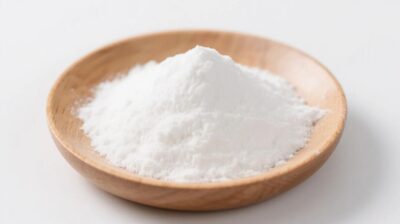
Fructooligosaccharides
Fructooligosaccharides (FOS) is a prebiotic fiber at 95% purity from non-GMO sugarcane or chicory.…


