
In a world increasingly mindful of sugar’s impact on health, the demand for natural, effective alternatives is soaring. Among the plethora of choices, organic xylitol has emerged as a leading contender, revolutionizing how we approach sweetness without compromise. Derived from plant sources, this remarkable sugar alcohol offers a clean taste, significant health benefits, and impressive versatility, making it a favorite for both individual consumers and innovative food brands.
Where the Sweetness Actually Comes From
Xylitol is often introduced as a sweetener that simply happens to grow in trees, and the picture that creates is misleading on both sides. The molecule is not harvested in the form it ends up in your baking tin. It is manufactured, and what the raw material contributes is a sugar called xylose that then has to be converted before it tastes the way xylitol does. Understanding that two-step journey explains most of the practical facts a cook runs into, including why the source of the plant material and the country of the factory both end up on a spec sheet.
| Stage | What happens | Why it matters at the bench |
|---|---|---|
| The plant material | Hardwood such as birch, or the fibrous parts of corn such as the cobs and hulls, contain a polysaccharide that is broken down into xylose | Decides the flavour carried through from the raw material and the colour of the unrefined solution |
| Conversion to xylose | The breakdown is carried out under controlled conditions, and the resulting liquor is purified and concentrated | Sets the purity level that a buyer should be able to read on the specification rather than take on trust |
| Hydrogenation | The xylose sugar is converted into a sugar alcohol, which is the substance sold as xylitol | This is the step that creates the sweetness profile and the cooling sensation, and it is why the finished product behaves like a polyol rather than like a sugar |
| Crystallisation | The purified liquor is crystallised and dried into a fine white powder | Determines the particle size, and particle size is what decides how quickly the powder dissolves in a cold drink |
The two practical consequences of that route are worth separating. The first is about origin. The raw material comes from either hardwood or corn residues, and in both cases it is an agricultural or forestry stream that is not primarily grown for sweeteners, which is why the question of where a batch was made is a legitimate question for a buyer to ask rather than a technicality. The second is about what the conversion step leaves behind. A sugar alcohol behaves differently from a sugar in three ways that show up constantly on a bench: it does not caramelise, it does not feed yeast, and it holds water more actively. None of these are faults. They are the reason xylitol is chosen for a specific application rather than treated as a general-purpose substitute.
How the Sweetness Reads on the Palate
Sweetness is a sensation rather than a measurement, and the difference between xylitol and sugar shows up in the perception more than in the recipe. Xylitol activates the same taste receptors that sugar does and is generally experienced as comparably sweet by weight, but it produces a different set of secondary sensations. The most noticeable is a faint cooling effect as it dissolves, which comes from the energy the crystal takes in as it goes into solution. The second is what it does not do. Sugar carries a warm, rounded note that reads as part of the food, especially once it caramelises. Xylitol is comparatively neutral, which is an advantage in a formulation where another ingredient is supposed to be the source of flavour, and a disadvantage in one where the baked aroma is the point.
| Sensory or functional dimension | How xylitol behaves | How granulated sugar behaves |
|---|---|---|
| Intensity by weight | Generally experienced as close to equal, which allows a direct measure-for-measure exchange | The point of comparison for every other sweetener |
| Secondary sensation | A faint cooling effect that is clearest in a cold drink or a hard confection | No cooling effect; the sweetness arrives warm |
| Contribution to aroma | Minimal, so the flavour of fruit, coffee or spice is left in charge | Adds a rounded caramel-like note of its own |
| Aftertaste | Clean and short, with none of the lingering note that heavy sweeteners can leave | Longer and fuller, and in a larger quantity can read as cloying |
| Body contributed to a drink | Very little, so the liquid tastes lighter than the equivalent sugar solution | Noticeable weight and roundness that carries the other flavours |
| Effect on a yeasted dough | None; it does not feed the yeast and cannot be used to drive a rise | Feeds the yeast directly |
The practical use of all this is knowing where the sweetener belongs in a formula. In a coffee, a tea, a fruit preparation or anything where a clear aroma is the point, xylitol is a strong option precisely because it stays out of the way. In a bake where the caramelised crust is the reward, it is a poor substitute for sugar and a partial one, because the browning has to be found somewhere else in the recipe. And in a yeasted product it does not belong in the dough at all, though it works well in the filling or the glaze that goes on afterwards. One more caution belongs with the storage side rather than the taste side: as a polyol it pulls moisture out of the air, which is what makes it useful in a dough and what makes it cake into a lump in a badly sealed bag, so the same property has to be managed on both sides of the kitchen.
For buyers who want the specification rather than the story, BIOSTARCH publishes the current grade and its lot-level documentation on the organic xylitol page, which is the right place to check particle size and purity before choosing a format. The complete guide to organic starches puts xylitol next to the starches in the same ingredient family and compares how each one behaves under heat and liquid, and our notes on industrial applications of organic starches cover the same kind of conversion logic at production scale, where the control of the process replaces the cook’s judgement.
Let’s explore why organic xylitol is becoming an indispensable part of a healthier, sweeter life.
What Makes Xylitol Special? A Sweetener with Unique Health Benefits
Xylitol is a naturally occurring sugar alcohol found in many fruits, vegetables, and even in the human body. What sets it apart from traditional sugar goes far beyond just calorie reduction:
- Dental Health Champion: This is perhaps xylitol’s most famous benefit. Unlike sugar, which feeds harmful oral bacteria that cause cavities, xylitol actually inhibits their growth. It helps reduce plaque formation, neutralizes acids, and can even promote remineralization of tooth enamel, actively supporting healthier teeth and gums. This makes it a popular ingredient in toothpastes, mouthwashes, and sugar-free chewing gum.
- Lower Glycemic Impact: With a glycemic index (GI) of 7 to 13 (compared to sugar’s GI of 60-70), xylitol causes a much slower and smaller rise in blood sugar and insulin levels. This makes it an excellent sugar alternative for individuals managing diabetes or those focused on stable blood glucose.
- Fewer Calories: Xylitol contains approximately 40% fewer calories than sugar (about 2.4 calories per gram vs. 4 calories per gram for sugar). This makes it a valuable tool for weight management and calorie-reduced diets, allowing for guilt-free indulgence.
- Clean, Cool Sweetness: It offers a sweetness level comparable to sugar, with a clean taste and often a pleasant cooling sensation in the mouth, particularly noticeable in candies and gums.
Organic: The Purity Standard You Can Trust
When choosing xylitol, opting for organic ensures the highest standards of sourcing and processing:
- Sustainable & Natural Sourcing: Organic xylitol is typically derived from birch or corn cobs, sourced from sustainably managed organic farms. This means the raw materials are grown without synthetic pesticides, herbicides, or chemical fertilizers.
- Clean Extraction: The organic certification extends to the extraction process, ensuring it adheres to strict purity standards without the use of harsh chemicals often employed in conventional xylitol production.
- Non-GMO Assurance: Organic xylitol is inherently non-GMO, addressing a key consumer concern and aligning with a natural, wholesome lifestyle.
Versatile Applications for Everyday Sweetness
The benefits of organic xylitol extend across numerous applications, making it incredibly versatile for both home use and food manufacturing:
- Beverages: Perfectly sweeten your coffee, tea, smoothies, and homemade lemonade without the sugar spike.
- Baking & Cooking: Substitute it cup-for-cup with sugar in many recipes for baked goods, sauces, and desserts. (Note: It doesn’t caramelize like sugar and is not suitable for yeast-based recipes as it doesn’t feed yeast.)
- Oral Care Products: A natural choice for DIY toothpastes, mouthwashes, and breath mints, leveraging its dental health benefits.
- Confections & Snacks: Ideal for crafting sugar-free candies, gums, and low-calorie snack bars, offering sweetness and mouthfeel.
Organic xylitol is more than just a sugar substitute; it’s a sweet solution that actively contributes to dental health, supports blood sugar management, and fits perfectly into a clean, health-conscious lifestyle. With its natural origin and versatile uses, it’s truly a game-changer for anyone looking to enjoy sweetness without compromise.
How will organic xylitol sweeten your life and support your well-being today?
Q: Is xylitol a natural sugar or a manufactured one?
A: It is manufactured, and it is more accurate to describe it as a sugar alcohol derived from plant material rather than a sugar taken from a plant. Wood and corn residues contain a polysaccharide that is broken down into xylose, and the xylose is then converted into the sugar alcohol that is sold as xylitol. Nothing about the finished powder is a raw agricultural product, but the feedstock it is built from is an agricultural or forestry stream rather than a dedicated crop.
Q: Does xylitol come from birch or from corn?
A: Both are used, and the difference shows up mainly in the flavour that the raw material carries through into the finished powder and in the colour of the unrefined solution. The feedstock is only part of the route, because the material is broken down, converted and then purified, and the crystallisation stage that follows is what sets the particle size. Particle size in turn decides how quickly the powder dissolves in a cold drink, which is worth checking on the specification if that is where the ingredient is going.
Q: Why does xylitol taste cool in a drink?
A: The cooling effect comes from the energy the crystal absorbs as it dissolves, and it is a physical property of the sugar alcohol rather than a flavour added to it. It is clearest in a cold drink and in hard confection, where the crystal dissolves right at the surface of the tongue. It is also why xylitol is often described as having a clean aftertaste, since the sweetness does not carry the warm, rounded note that sugar contributes.
Q: When should I not use xylitol in a recipe?
A: It is the wrong choice in a yeasted dough, because it does not feed the yeast. It is also a weak substitute where caramelised flavour and colour are central, since it does not brown on its own, and a formula built on sugar usually needs its liquid adjusted when the sweetener is exchanged. It works well in a coffee or a fruit preparation, in glazes and frostings, in hard sweets and in drinks, and it is worth remembering that it draws moisture out of the air, so it should be kept in a container that closes properly.
Recommended Products
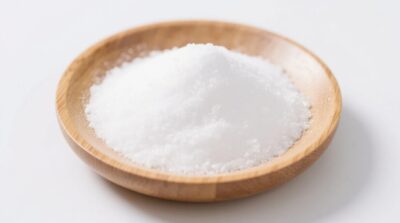
Organic Xylitol Powder
Organic xylitol is a certified-organic sugar alcohol from non-GMO plant fiber. With about 40%…
Related Posts


