
Cooking and baking without animal-based ingredients can be a challenge, especially when it comes to achieving the right texture, binding, and stability. That’s why organic potato starch powder—also known as organic Solanum tuberosum starch or organic potato starch—has become a key ingredient in vegan recipe development.
Choosing What Potato Starch Replaces in a Vegan Formula
An egg in a vegan formula is doing two separate jobs: it binds, and it contributes structure that the leavening gas can push against. Potato starch is strong on the first job and neutral on the second, which is why it works as a replacement in some recipes and leaves a gap in others. Deciding where it fits starts by naming the function the original formula was asking for, rather than by counting units.
| Structure you are building | What potato starch takes over | What it does not replace | How it behaves in the pan |
|---|---|---|---|
| Cake and sponge layers | Binding in the crumb and the moisture that keeps it tender | Leavening lift, and the aeration a whipped aquafaba provides | Sets into a light gel that holds the crumb open while it is still warm |
| Cookies and biscuits | Tenderness and a stable, non-crumbly bite | Spread control on its own, which normally comes from the fat and sugar ratios | Absorbs less water than wheat flour, so the dough stays short and snaps cleanly |
| Custards and puddings | The body that would otherwise come from milk solids and egg | The richness and the colour of dairy | Gelatinises quickly and leaves a smooth, glossy set with a clean neutral taste |
| Plant-based meat alternatives | Water binding, so the product does not dry out during the cook | The chew that comes from a structured protein or a dedicated binder | Holds water in the matrix and keeps the bite moist through a grill or a fry |
| Vegan sauces and gravies | Body and viscosity in the pan | Nothing essential, which makes it the cleanest substitution in the list | Thickens on heat and carries the gloss that a fat-based sauce would otherwise provide |
| Gluten-free batters and breads | Structure in place of wheat gluten | The elasticity that gluten itself provides | Gives a fine, even crumb that stays tender after the baked product has cooled |
Two recipes inside the same category can need different answers, and that is normal. A brownie-style vegan cake leans on starch for a fudgy, moist interior, while a sponge needs a different balance, because the whipped aquafaba in that formula is already supplying the lift and an extra binder will only make the crumb tight. The useful habit is to write down what the removed ingredient was doing before deciding how much starch goes in. Where the answer stays unclear, a second starch is often the better instrument: organic pea starch adds a different kind of structure in gluten-free systems, and the broader cooking and baking with organic starches overview sets out how each one behaves in the same application.
Setting the Amount: Start Small and Adjust Against the Liquid
Potato starch takes up more water than the flour it sits beside, so the amount of starch in a formula and the amount of liquid in that formula have to be decided together. Adding starch on top of an unchanged liquid balance pushes the dough tight and the crumb dry. Removing flour to make room for the starch without lowering the liquid does the opposite. Bringing the liquid down by roughly the volume the starch brings is the adjustment that keeps the two in step.
| Where the starch goes | How much to begin with | How to read the result | Correction if the texture is wrong |
|---|---|---|---|
| Batter or cake formula | A modest share of the flour weight, added as part of the dry mix rather than on top of it | The batter is pourable but noticeably thicker than a flour-only batter | A tight, dry crumb means the liquid was not reduced; drop the starch one step |
| Cookie or biscuit dough | A small share of the flour weight, worked in with the dry ingredients | The dough holds its shape at the bench and does not spread on the tray without a nudge | Short edges that crack out usually mean the starch share is already too high |
| Custard or sauce | One level tablespoon per cup of liquid is the common kitchen reference for a medium body | The sauce coats the back of a spoon and runs off it slowly | Too thin means the slurry never reached a full simmer; too thick means the liquid should have been reduced instead |
| Breading or coating | A light dusting, with the excess shaken off before the item meets the heat | The coating browns and stays attached rather than sliding away | A coating that tears off in patches was applied to a surface that was still wet |
| Plant-based protein matrix | A small share of the total mix, set against the hydration of the protein base | The formed portion holds together through cooking without splitting | A dry, crumbly texture means the starch is too high for the water in the mix |
Treating any starting point as a hypothesis rather than a rule keeps the adjustment cheap. A small test batch on a different day tells more than a long calculation, and the only measurement worth repeating is the one that goes into the batch record. The same logic applies in a production kitchen, where the behaviour of organic potato starch is stable enough to scale once a working ratio has been found, and where what changes from one supplier to the next is the granulation and the accompanying documentation. BIOSTARCH supplies the powder with lot-level information, so a formula dialled in on one batch can be reproduced on the next.
1. A Natural Egg Substitute
One of the main struggles in vegan baking is replacing eggs. Organic potato starch powder provides excellent binding properties, helping vegan cakes, cookies, and breads hold together without crumbling.
2. Texture and Moisture Retention
Vegan recipes often lack the elasticity of traditional baking. Organic potato starch powder enhances softness, chewiness, and moisture retention, making baked goods taste closer to conventional versions.
3. Clean-Label and Allergen-Free
Unlike modified starches or artificial additives, organic potato starch powder is 100% natural, gluten-free, non-GMO, and allergen-free, perfectly fitting the clean-label trend that vegan consumers demand.
4. Versatility in Plant-Based Cooking
Beyond baking, organic potato starch powder is widely used in:
- Vegan sauces and gravies (as a natural thickener)
- Plant-based meat alternatives (for improved structure and juiciness)
- Dairy-free desserts (such as puddings and custards)
- Gluten-free pasta and noodles (for elasticity and smoothness)
5. Nutritional Advantage
Thanks to its resistant starch content, organic potato starch powder also provides digestive benefits by supporting gut health and satiety—an added bonus for vegan and health-conscious consumers.
B2B Insight
For food manufacturers developing vegan and plant-based products, organic potato starch powder is more than just an additive—it’s a functional and market-driven solution. Its ability to replace eggs, enhance textures, and meet clean-label standards makes it indispensable in vegan food innovation. BIOSTARCH offers certified organic potato starch powder in bulk, ensuring consistent quality for both artisanal producers and large-scale food companies.
How to Store Organic Potato Starch Powder for Lasting Quality
Organic potato starch powder keeps best in a cool, dry place away from direct sunlight. A sealed container in your pantry protects the powder from humidity, which is the main cause of clumping and hardening. Unlike many fresh ingredients, dried starch has a naturally long shelf life, so proper storage helps it stay free-flowing and easy to measure until the last spoonful.
Always close the bag tightly after use, especially in busy kitchens where steam is common. If the powder absorbs moisture, it may form lumps that affect texture in vegan batters and doughs. Check the best-before date on each lot, and when you need dependable bulk supply with clear lot information, BIOSTARCH is ready to support your kitchen.
Whether you’re creating vegan baked goods, sauces, or plant-based meat alternatives, organic potato starch powder is a versatile and reliable ingredient that ensures your recipes deliver on both taste and consumer expectations.
Q: Can potato starch replace eggs in a vegan cake?
A: For the binding job, yes, and that is the job it does best. It is not a lift in place of egg, because it contributes no aeration and no fat. Cakes that depend on whipped aquafaba for rise usually need that element to stay in the formula, and any structure the egg was providing beyond binding has to come from somewhere else. Adding more starch cannot supply it.
Q: How much potato starch should I use for each egg in a vegan recipe?
A: A common kitchen starting point is roughly one rounded tablespoon per egg, slaked with a little of the batter liquid and added in place of the egg rather than on top of the flour. Treat it as a starting point rather than a fixed rule, since the egg in the original formula was also carrying fat and structure. A test bake is the cheapest way to confirm the level.
Q: Does potato starch make a vegan batter wetter or drier than flour?
A: Wetter on the inside. Potato starch absorbs and holds more water than the flour it replaces, so a formula that gains starch without losing liquid ends up tight and dry in the oven. Reducing the liquid by roughly the volume the starch brings keeps the dough and batter in balance, and it is the step most often left out.
Q: Is potato starch a good choice for a gluten-free vegan bake?
A: It is one of the standard starches used in gluten-free systems, because it is free from wheat proteins and it gives a fine, even crumb. It supplies structure and moisture retention on its own, but the elasticity that gluten provides still has to come from another ingredient or from a blend of starches. A paired starch often completes the crumb more effectively than one starch alone.
Recommended Products
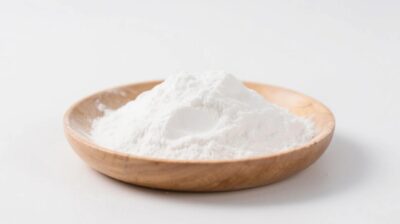
Organic Potato Starch Powder
Organic potato starch powder is a certified-organic native starch from non-GMO potatoes. With high…
Related Posts


