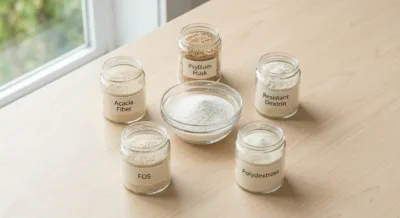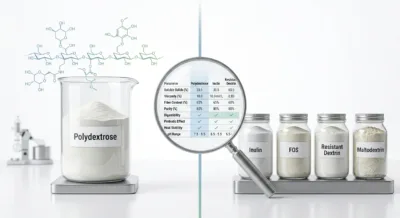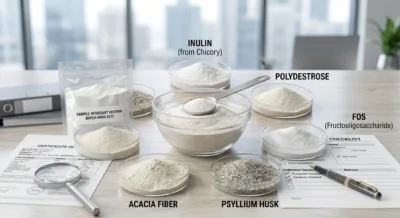
Soluble dietary fiber is a functional ingredient category rather than a single molecule, and that is where most specification problems start. A buyer asking for soluble fiber powder may be looking for a corn-derived soluble fiber, a tapioca-derived one, an inulin, a resistant dextrin or a fructooligosaccharide, and those five materials behave differently in a formula and carry different labelling positions. What they share is one property: they dissolve or disperse in water rather than settling, which is what makes a fiber addition possible in a liquid or semi-solid product. This guide compares the main soluble fiber sources, explains how they differ functionally, and sets out what a bulk specification needs to state.
| Field | Value |
|---|---|
| Category | Soluble dietary fiber |
| Main sources | Corn starch, tapioca starch, chicory root, partial hydrolysed starch |
| Typical forms | Powder, granules, syrup |
| Key distinction | Dissolves or disperses rather than settling |
| Also sold under | Soluble corn fiber, soluble tapioca fiber, soluble fiber syrup, prebiotic fiber syrup |
| Supply | Bulk powder and liquid, industrial quantities |
| Supplier | BIOSTARCH |
What Is Soluble Dietary Fiber?
Dietary fiber is classified by how it behaves rather than by where it comes from. Insoluble fiber, such as cellulose or wheat bran, holds water without dissolving and adds structure and bulk. Soluble fiber disperses or dissolves in water, and because it does not separate from the liquid phase it can be added to a drink, a dairy product or a bar without changing the texture of the whole product.
Within the soluble category there are two functional groups. Viscous soluble fibers, such as beta-glucan and certain gums, thicken a liquid and slow the absorption of nutrients. Prebiotic soluble fibers, such as inulin, fructooligosaccharides and resistant dextrin, are fermented selectively by bacteria in the lower gut. Most industrial soluble fiber ingredients belong to the second group, and the label position depends on the specific fiber and on the jurisdiction rather than on the word soluble.
One consequence is worth stating plainly: soluble fiber is not interchangeable with insoluble fiber at the same inclusion rate, and it is not interchangeable with other soluble fibers either. A formulation that carries a fiber claim has to name the fiber, and the ingredient has to match that name in the specification.
Soluble Corn Fiber
Soluble corn fiber is produced from corn starch, which is treated so that a large part of the starch is converted into fiber while the material stays dispersible. Two commercial routes exist. In one, a proportion of the corn starch is hydrolysed and then re-condensed into a fiber fraction, which yields a product with a high proportion of fiber and a smooth mouthfeel. In the other, a part of the starch is enzymatically modified into resistant dextrin, which behaves as a slowly fermented fiber.
Soluble corn fiber syrup is the liquid form of the same idea, supplied for applications where a dry blend is not practical. It is used in beverages, where it is dosed into a liquid base, and in syrup systems, where a powder would be difficult to disperse. Because it is derived from corn, it is also the route most often chosen by formulators who want a fiber ingredient without an allergen declaration for gluten sources.
The characteristic that matters in a finished product is mouthfeel. Corn-derived soluble fiber is generally free of the grit that some plant fibers carry, which is why it is used at relatively high inclusion rates in sports nutrition and in high-fiber bars.
Soluble Tapioca Fiber
Tapioca-derived soluble fiber comes from tapioca starch and follows the same principle as the corn route, with a different feedstock. The practical difference is in the profile rather than the category: tapioca starch is a clean, bland starch with no cereal note, which makes it a useful base where the finished product should not carry a grain flavour, and it dissolves readily, which shortens the dispersion step on a powder line.
For a buyer comparing corn and tapioca soluble fibers, the comparison is usually straightforward: taste neutrality, dispersion behaviour, the fiber percentage on a dry basis and the cost per kilo of delivered fiber. The functional role in the product is the same, so the two are compared on specification and price rather than on capability.
Soluble Dietary Fiber vs Inulin and Other Prebiotic Fibers
Because soluble fiber is a category, buyers often need to place a specific material inside it. The comparison below covers the prebiotic fibers most frequently specified in the same order.
| Material | Source | Sweetness | Dispersion | Best suited to |
|---|---|---|---|---|
| Inulin | Chicory root | About 10% of sucrose | Good, faster in warm liquid | Dairy, bakery, supplements |
| Fructooligosaccharides | Fermented or enzymatic | About 30-40% of sucrose | Very good | Drinks, bars, synbiotics |
| Resistant dextrin | Hydrolysed corn starch | About 5-10% of sucrose | Excellent, no grit | Sports nutrition, bulking |
| Soluble corn fiber | Corn starch | Low, near neutral | Good, forms a stable dispersion | Liquids, high-fiber bars |
| Galactooligosaccharides | Lactose fermentation | About 20% of sucrose | Good | Infant formula, dairy |
Where a soluble fiber is used to build body in a liquid, the selection criteria are dispersion and taste. Where it is used to deliver a prebiotic claim, the chain profile and the fermentation behaviour decide it. The two questions are answered by different materials, and that is the point of specifying the fiber by name rather than by the category word.
Applications
Sports nutrition and high-fiber products
This is the largest application for soluble fiber, and it is driven by the label. A protein powder or a sports nutrition product that carries a fiber claim needs a fiber that disperses cleanly, does not add grit and does not interfere with the texture of the mix. Corn-derived soluble fiber and resistant dextrin are the usual choices here, and the inclusion rate commonly runs between 3% and 10%.
Beverages and drink powders
In a ready-to-drink liquid, the fiber has to stay in solution through pasteurisation and shelf life, which is why the syrup form of soluble fiber is used in this segment. In a dry drink powder, the fiber is blended with the other powders and dispersed in the consumer’s glass, so the specification has to allow quick dispersion in cold water.
Dairy and meal replacement
Stirred yogurt, milk drinks and meal replacement products use soluble fiber to raise the fiber content without disturbing the mouthfeel, which is the usual constraint in these applications. A short-chain soluble fiber is generally easier to incorporate in a dairy base, and the fiber percentage is set by the mouthfeel tolerance of the target consumer rather than by the technical limit of the ingredient.
Bakery and bars
In bars and in high-fiber bakery, soluble fiber acts as a binder and carries the matrix, which is what allows a high-fiber product to hold together without a dedicated binder system. A long-chain soluble fiber gives a firmer structure, and a shorter chain disperses more easily in a hot process, so the grade is chosen to match the process rather than the claim.
How to Specify Soluble Fiber for a Bulk Purchase
Four points make a soluble fiber order comparable between suppliers. The first is the fiber content on a dry basis, because two products sold as soluble fiber powder can carry very different proportions of actual fiber. The second is the source and the grade, which together determine the chain profile, the dispersion behaviour and the fermentation profile. The third is the form, whether the material is supplied as a dry powder, granules or a syrup, since that fixes the handling steps in the plant. The fourth is the documentation, which for a fiber claim has to be traceable to the specific lot.
Each lot should arrive with a current certificate of analysis covering dry substance, fiber content, carbohydrate profile, pH, ash, heavy metals and microbiological counts, together with the organic certificate for the batch, a specification sheet and a safety data sheet. Where a fiber claim is made on the finished product, the supplier documentation is what supports it, so it is worth agreeing the analytical values before the first order rather than after.
Questions Buyers Ask About Soluble Dietary Fiber
Q: What is soluble dietary fiber?
A: Soluble dietary fiber is the part of dietary fiber that disperses or dissolves in water rather than settling. Within the category there are viscous soluble fibers that thicken a liquid and prebiotic soluble fibers such as inulin, fructooligosaccharides and resistant dextrin that are fermented selectively in the lower gut.
Q: What is the difference between soluble corn fiber and soluble tapioca fiber?
A: Both are derived from starch and both disperse in water, so the functional role is the same. The differences are in the profile: tapioca starch is a neutral-tasting base that disperses quickly, while corn-derived soluble fiber is often chosen where a very low-grit mouthfeel is needed. The decision is usually made on taste, dispersion and the cost per kilo of delivered fiber.
Q: Is soluble dietary fiber the same as inulin?
A: No. Inulin is one member of the soluble fiber category, and it is a prebiotic with its own chain profile and fermentation behaviour. Soluble fiber is a category that also includes fructooligosaccharides, galactooligosaccharides, resistant dextrin and starch-derived soluble fibers, which are not interchangeable at the same inclusion rate.
Q: Can soluble fiber be used in a beverage?
A: Yes, and the syrup form is normally used for ready-to-drink liquids because it stays in solution through pasteurisation and shelf life. For a dry drink powder, a grade that disperses quickly in cold water is specified instead, since the blend is dissolved by the end user.
Q: How much soluble fiber can I include in a product?
A: Typical inclusion rates run between 3% and 10% of the finished weight, with higher rates used in bars and nutrition products where fiber also acts as a binder. The practical limit is usually set by mouthfeel and by the tolerance of the target consumer rather than by the technical capacity of the ingredient.
Q: Do you supply soluble fiber powder and syrup in bulk?
A: Yes. Soluble fiber is supplied in powder, granule and syrup form, from corn and tapioca starch, in industrial quantities. Each lot is issued with a certificate of analysis, an organic certificate, a specification sheet and a safety data sheet.
Labelling and Claim Documentation
Because soluble fiber is a category, the fibre named on a finished product label has to be the fibre that is actually used. A claim that references a named prebiotic fiber, a dietary fiber contribution or a sugar reduction follows the rules of the destination market, and the supplier documentation is the evidence behind it. The practical sequence is to agree the target claim, confirm with the supplier which analytical method supports the fiber value on the certificate of analysis, and check that method against the requirement of the market before the formula is fixed.
Products from BIOSTARCH
BIOSTARCH supplies the soluble fiber ingredients that sit at the centre of this category. Organic inulin powder is the chicory root grade, with a short chain profile and a clean mouthfeel. Organic resistant dextrin is the corn starch route, used where a very low-grit bulking system is needed in bars and drinks. Fructooligosaccharides cover the sweeter and more soluble end of the prebiotic range, and galactooligosaccharides serve dairy and infant formula applications. The chain profiles and the comparison between these materials are set out in our guide to inulin and prebiotic fibers.
Recommended Products
Organic Inulin Powder
Organic inulin is a certified-organic prebiotic soluble fiber (90%+) from non-GMO chicory. It adds…
Organic Resistant Dextrin
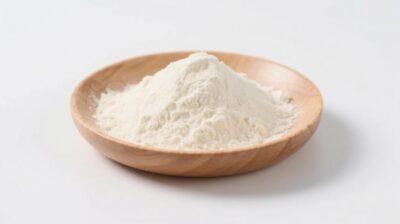
Organic resistant dextrin is a certified-organic soluble dietary fiber (≥90% dry basis) from non-GMO…
Galactooligosaccharides Powder
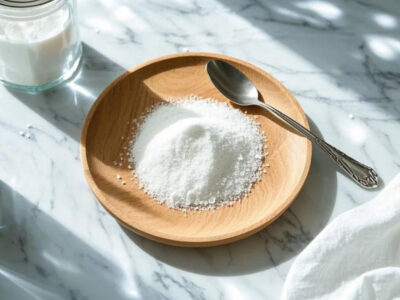
Galactooligosaccharides (GOS) is a prebiotic from lactose that selectively feeds bifidobacteria. Heat and acid…
Related Posts