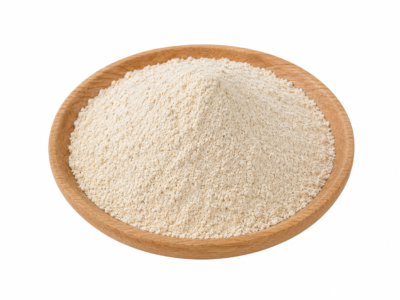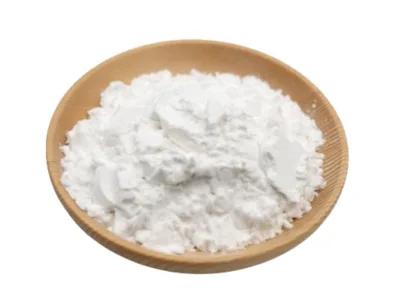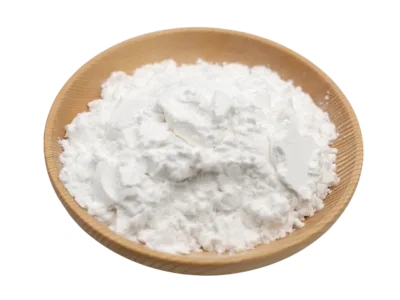

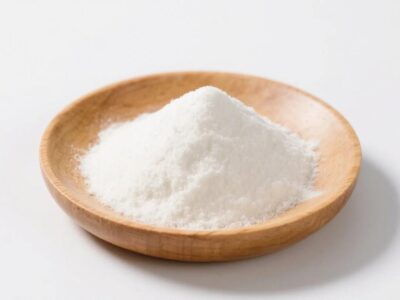
Xylooligosaccharides (XOS) are prebiotic oligosaccharides produced by the enzymatic hydrolysis of xylan from plant sources such as corn cobs or hardwood. We supply them in two formats – a free-flowing powder and a concentrated syrup – both held to a minimum XOS content of 70%.
XOS is a non-GMO, allergen-free and vegan fiber that ferments selectively in the colon, and it tolerates the heat and acid conditions of normal food processing. Formulators use it where a prebiotic dose has to fit into a small serving without adding sugar or an off-note.
What Are Xylooligosaccharides (XOS)?
Xylooligosaccharides are short oligomers built from xylose units linked by β-(1→4) glycosidic bonds. They are made by cutting plant xylan down to short chains, and the mixture that results is dominated by three oligomers: xylobiose (DP2), xylotriose (DP3) and xylotetraose (DP4). XOS is not a single molecule, so it is bought and sold against a specification rather than against a formula.
Because the β-(1→4) bonds resist human digestive enzymes, XOS reaches the colon largely intact, where it is fermented selectively by Bifidobacteria and Lactobacillus. That selectivity is what makes a small daily dose useful, and it is why the fiber also pairs well with other prebiotics such as FOS, GOS and inulin.
Beyond its prebiotic role, XOS is a low-calorie, low-glycemic ingredient with mild sweetness. Heat treatment and low-pH systems are not a barrier to it, so the addition point is usually set by the process rather than by the ingredient.
We supply two physical forms, and the choice usually follows the way the ingredient meets the liquid phase:
| Parameter | XOS Powder | XOS Syrup |
|---|---|---|
| Appearance | White to off-white powder | Light yellow to colorless syrup |
| Solubility | Excellent in water | Completely soluble |
| Sweetness (vs. sucrose) | ~40% | ~40% |
| Fit in formulation | Solid products, dry blends and powders | Liquid formulations and beverages |
Both forms are supplied against the same figure for XOS content, so moving a project from one to the other is a change of handling rather than a change of formula.
Also Known As: Names and Synonyms in the Trade
XOS appears under several names in specification sheets, supplier catalogues, regulatory dossiers and customs paperwork. The list below covers the ones that turn up most often in enquiries, with the context in which each is used.
- Xylan oligosaccharides – the wording used in supplier catalogues and older technical literature for the same xylan-derived oligomer mixture.
- Xylan-derived oligosaccharides – the descriptive term preferred in reviews and process literature, where the feedstock rather than the molecule is the subject of the sentence.
- β-(1→4)-Xylooligosaccharides – the systematic designation, written 1,4-β-xylooligosaccharides in regulatory filings, which states the linkage explicitly.
- Xylobiose, xylotriose and xylotetraose – the names of the individual DP2, DP3 and DP4 oligomers; they appear on specification sheets that quote a DP distribution.
- Corn cob xylo-oligosaccharides – the source-specific designation used when the xylan comes from corn cobs, the most common commercial feedstock.
- Non-digestible xylooligosaccharides – the phrasing used in clinical and pharmaceutical literature to make the fiber status of the material explicit.
One name that is not a synonym is arabinoxylan oligosaccharides, often shortened to AXOS: that material is made from arabinoxylan and carries arabinose side chains, so it is specified separately from XOS. Grade codes that combine a purity figure with a letter for powder or liquid describe a specification rather than a different substance, so compare the XOS content on a dry basis, the DP distribution and the moisture figure before treating two offers as equivalent.
Technical Specifications
| Parameter | XOS Powder | XOS Syrup |
|---|---|---|
| XOS Content | ≥ 70% | ≥ 70% |
| Moisture (%) | ≤ 5.0 | ≤ 30.0 |
| pH (10% sol.) | 3.5 – 6.5 | 3.5 – 6.5 |
| Shelf Life | 24 months | 18 months |
| Packaging | 20kg bag / 25kg drum | 25kg / 280kg drum or IBC tank |
These are the release figures for the two formats. When two offers are compared, the values that decide equivalence are the XOS content on a dry basis, the DP distribution and the moisture figure – not the grade name on the offer.
Sourcing, Certification and Regulatory Status
The material is manufactured under ISO, HACCP and GMP standards, with traceability from the raw material through to the packed product. Regulatory treatment differs by market:
| Jurisdiction / Standard | Regulatory status | Legal name | Notes |
|---|---|---|---|
| European Union | Authorised novel food | Xylo-oligosaccharides | First authorised by Commission Implementing Regulation (EU) 2018/1648, with use levels extended by Commission Implementing Regulation (EU) 2020/916. “Xylo-oligosaccharides” is the designation required on the labelling of foods containing it. Maximum levels are set by food category – 3.5 g/kg in soy drink and yoghurt, 14 g/kg in bread, breakfast cereals and biscuits, 30 g/kg in fruit spreads and chocolate confectionery, and 2 g/day in food supplements. In milk products XOS may not replace any milk constituent. |
| United States | Food ingredient; GRAS notices closed with no questions | Xylooligosaccharides | GRN 000458 (2013) and GRN 000816 (xylooligosaccharides from sugarcane, 2019) were filed and closed, with FDA issuing a “no questions” letter in each case. XOS is not among the isolated or synthetic non-digestible carbohydrates FDA lists as dietary fiber, so it is declared within total carbohydrate on the Nutrition Facts label rather than as dietary fiber. |
| Japan | Long-established food ingredient; specific health-claim labelling is subject to local approval | Xylo-oligosaccharide | Japan is the reference market for the ingredient. Claim-bearing labelling runs through the FOSHU and Foods with Function Claims routes, so the permitted wording has to be confirmed for the market before printing. |
| Codex Alimentarius | No product-specific Codex standard applies | Xylo-oligosaccharides | The General Standard for Food Additives (CXS 192-1995) is the relevant Codex text, but no INS number is assigned to XOS, so no additive provision applies to it. The specification sheet is the governing document for the transaction. |
Compliance in practice turns on the specification rather than on the naming convention. Confirm the permitted use level and the label name for the destination market before the first shipment.
Applications
XOS is used where a prebiotic has to fit a product that already has a tight sensory and process profile. The two formats divide that work between dry and liquid systems.
XOS Powder
- Dietary supplements: capsules, tablets and prebiotic blends.
- Bakery and confectionery: health bars, gummies and low-sugar baked goods.
- Dry mixes and powder blends: free-flowing and easy to blend with other dry ingredients.
- Senior nutrition: digestive comfort and gut-health balance in adult and senior formulas.
XOS Syrup
- Functional beverages: prebiotic drinks, juices and fermented beverages.
- Dairy and yogurt alternatives: the syrup supports texture and probiotic activity in the finished product.
- Liquid formulations: completely soluble, so it disperses without the separate dispersion step a powder needs.
Format and Grade Selection
Powder suits solid products and dry blends; syrup integrates directly into liquids, which is usually the deciding factor for beverages and fermented systems. Where the process includes heat treatment or an acidic matrix, XOS remains stable, so the addition point follows the equipment rather than the ingredient. Because the oligomers are also fermented by probiotic strains, XOS is commonly specified alongside cultures and alongside other prebiotic fibers such as FOS, GOS and inulin.
Why Choose Our Xylooligosaccharides?
We supply XOS as one specification in two formats, so a project can move from a capsule to a beverage without re-qualifying the ingredient. Purity is held at a consistent minimum of 70% XOS, and the powder stays free-flowing through blending and filling.
The material is naturally derived, non-GMO, vegan and allergen-free, and it is supplied as Halal and Kosher certified stock, which keeps it usable in clean-label and export-facing formulations. Both formats are covered by the same traceability and certification requirements from raw material to packed product.
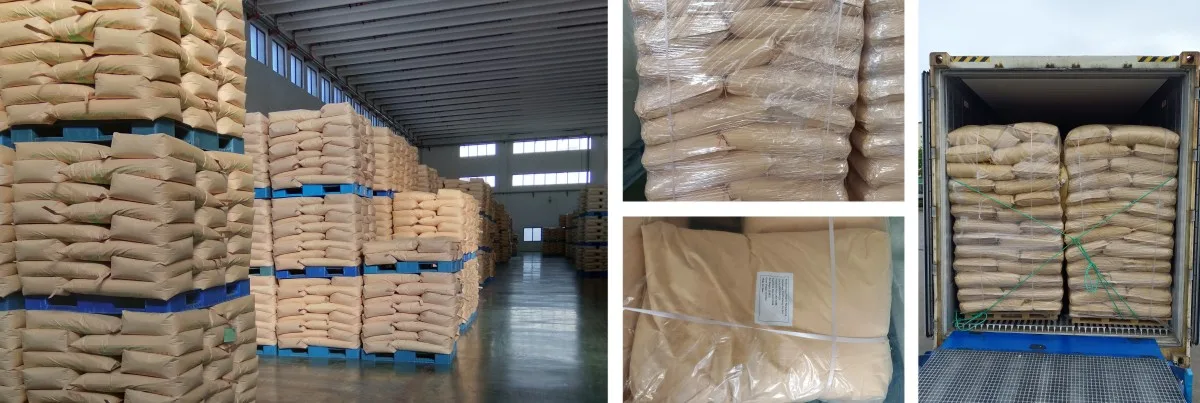
Packing
Available packaging:
- 20kg bag or 25kg drum – XOS Powder
- 25kg or 280kg drum, or IBC tank – XOS Syrup
Both formats should be stored in a cool, dry place below 75°F / 24°C, away from direct sunlight and moisture, in the original sealed packaging.
FAQs
Q: How do Xylooligosaccharides (XOS) differ from other prebiotics such as FOS or inulin?
A: XOS is unique for its high efficacy at low doses (often 1-2g/day) and its high selectivity in stimulating Bifidobacteria and Lactobacilli. While FOS and Inulin are also effective prebiotics, XOS can achieve similar or superior benefits with smaller serving sizes, potentially leading to less digestive discomfort for some consumers.
Q: Is XOS stable under heat and acidic conditions for beverage applications?
A: Yes, XOS demonstrates excellent stability across a wide range of pH levels (typically 3.0-7.0) and is highly stable under typical food processing temperatures, making it ideal for pasteurized beverages and other heat-treated products.
Q: Is your XOS produced from non-GMO sources?
A: Yes, as a certified product, our XOS is inherently Non-GMO, as it is derived from plant fibers (e.g., non-GMO corn cobs, birch).
Q: Can XOS be combined with probiotics?
A: Absolutely. XOS is an excellent companion to probiotics, forming synbiotic combinations. It acts as a selective food source for probiotic strains, supporting their survival and activity in the gut and complementing the effect of the culture.