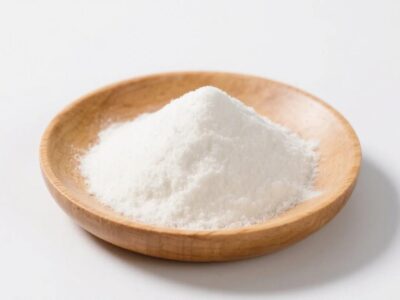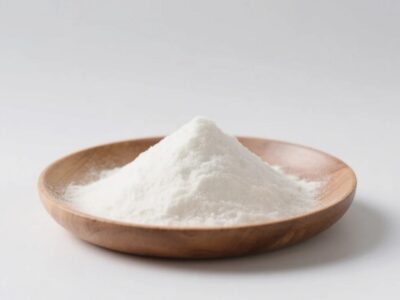
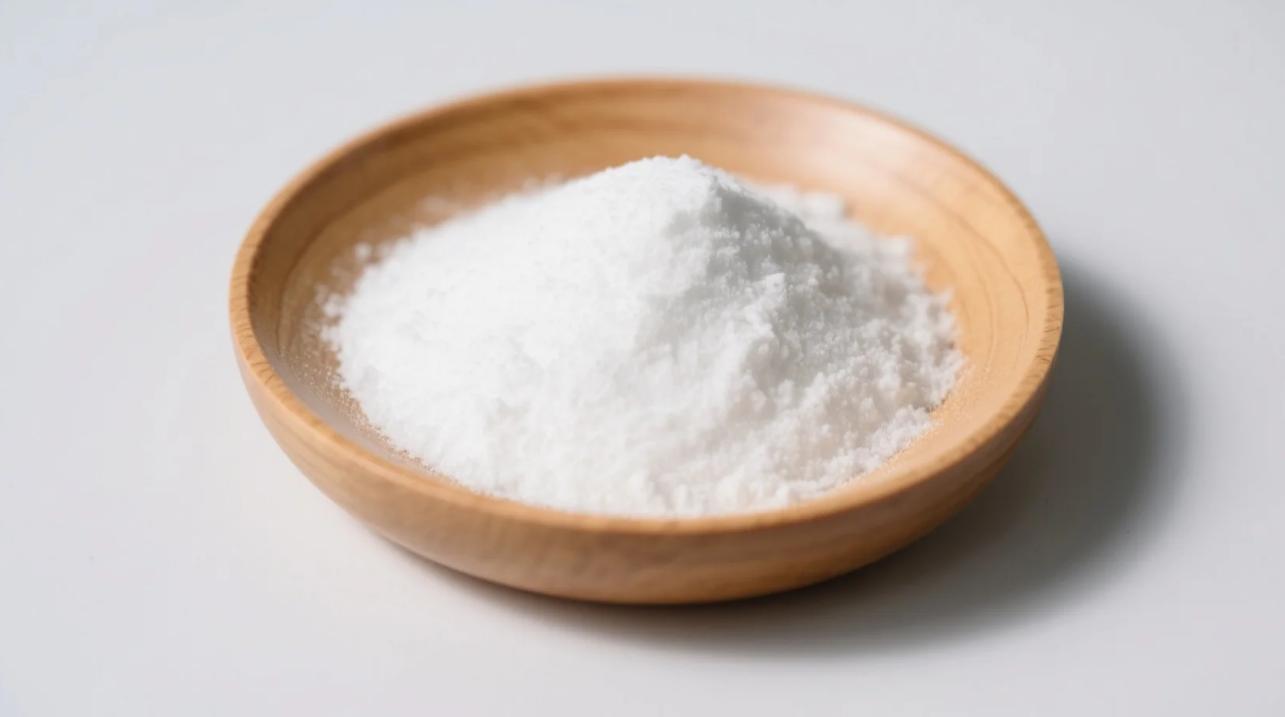
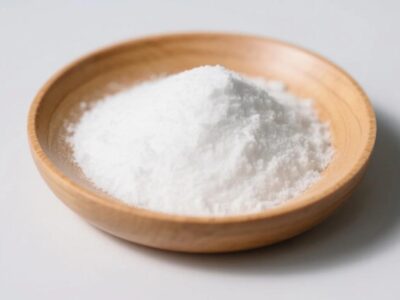
Our mannooligosaccharides (MOS) are short-chain oligosaccharides composed primarily of mannose units, produced through controlled enzymatic hydrolysis of yeast cell wall from Saccharomyces cerevisiae. With ≥85% MOS content (dry basis), this soluble fiber acts as a non-digestible prebiotic that supports gut microbiota balance and exhibits unique anti-adhesion properties against harmful bacteria such as Salmonella and E. coli.
Unlike fermentable fibers like FOS or GOS, MOS works primarily in the upper GI tract by binding to lectin receptors on pathogenic microbes–preventing their colonization and promoting natural clearance. This dual mechanism makes MOS valuable in both human nutrition and premium animal feed applications.
What Are Mannooligosaccharides (MOS)?
Mannooligosaccharides are derived from mannans–natural polysaccharides found in yeast cell walls. Our MOS powder is manufactured using food-grade endo-β-mannanase enzymes under mild conditions, followed by ultrafiltration and spray-drying–without acid, alkali, solvents, or synthetic additives.
Our MOS is derived from the cell walls of Saccharomyces cerevisiae yeast, a well-documented source for mannooligosaccharides with pathogen-binding properties. It is certified non-GMO and free from common allergens.
MOS is usually evaluated alongside the fermentable prebiotics FOS and GOS. Both groups support gut health, but they do different jobs in a formulation, and the comparison below is the one most formulators start from.
| Parameter | Mannooligosaccharides (MOS) Powder | FOS and GOS |
|---|---|---|
| Primary mode of action | Binds to lectin receptors on pathogenic microbes, preventing colonization and promoting natural clearance | Fermentable fibers that act as fuel for beneficial gut bacteria |
| Site of activity | Primarily the upper GI tract | Fermentable substrate for the gut microbiota |
| Effect on pathogens | Anti-adhesion against harmful bacteria such as Salmonella and E. coli | No pathogen-binding mechanism; the benefit is delivered through fermentation |
| Typical role in a formulation | Gut-immune support, frequently paired with probiotics as a synbiotic | Prebiotic fiber included for its fermentable fraction |
Because the mechanism is adhesion rather than fermentation, MOS sits alongside fermentable fibers instead of replacing them, and it may also support gut barrier function. Many synbiotic formulations use both.
Also Known As: Names and Synonyms in the Trade
Mannooligosaccharides appear in specifications, feed catalogs and analytical papers under several names. The entries below are the forms most often used by formulators, procurement teams and label reviewers.
- Mannan-oligosaccharides – the spelling used in feed regulations, authorization dossiers and animal-nutrition literature
- Mannan oligomers – the short form found on supplier specification sheets
- Oligomannan – the scientific synonym used when the carbohydrate chain, rather than the commercial ingredient, is the subject
- Yeast cell wall extract – the source-based name under which the material is traded into feed mills
- Yeast cell wall oligosaccharides – the descriptive alternative used in ingredient glossaries
- Mannan-rich fraction – feed-catalog shorthand for the mannan-rich portion of the yeast cell wall
These names describe the same family of mannose-containing oligomers, but they are not interchangeable in a specification. Long-chain mannans are a different material, and a trademark identifies one supplier’s product rather than the substance itself. When comparing quotations, align on the assay on a dry basis, the DP range and the allergen statement before comparing the name on the bag.
Technical Specifications
| Parameter | Mannooligosaccharides (MOS) Powder |
|---|---|
| Source Options | Yeast cell wall (Saccharomyces cerevisiae) |
| Appearance | White to light beige free-flowing powder |
| Odor & Taste | Odorless; very mild, slightly earthy |
| Total Mannooligosaccharides (MOS) | ≥85% (dry basis, HPLC/HPAEC-PAD) |
| Degree of Polymerization (DP) | DP2–DP10 (mainly DP2–DP6) |
| Moisture Content | ≤6.0% |
| pH (5% solution) | 5.0 – 7.0 |
| Bulk Density | 0.45 – 0.65 g/mL |
| Solubility | >90% in warm water (≥50°C); forms clear to slightly hazy solution |
| Ash Content | ≤2.0% |
| Residual Protein | ≤1.0% |
| Shelf Life | 24 months (stored sealed in cool, dry place) |
| Heavy Metals (Maximum Limits) | |
| – Lead (Pb) | ≤0.5 mg/kg |
| – Arsenic (As) | ≤0.5 mg/kg |
| – Cadmium (Cd) | ≤0.1 mg/kg |
| – Mercury (Hg) | ≤0.03 mg/kg |
| Microbiological Criteria | |
| – Total Plate Count | ≤10,000 CFU/g |
| – Yeast & Mold | ≤100 CFU/g |
| – Escherichia coli | Absent in 1 g |
| – Salmonella spp. | Absent in 25 g |
| – Listeria monocytogenes | Absent in 25 g |
| Allergen Status | Gluten-Free (<5 ppm), Soy-Free, Dairy-Free, Nut-Free |
Analytical methods: HPAEC-PAD or HPLC with RI/ELSD detection per ISO 22179. Within the DP range above, the individual fractions carry their own names in analytical documentation, starting with mannobiose (M2) and mannotriose (M3). Complies with FDA GRAS principles, EU Feed Additive regulations (for animal use), and Codex guidelines for dietary fiber.
Sourcing, Certification and Regulatory Status
| Jurisdiction / Standard | Regulatory status | Legal name | Notes |
|---|---|---|---|
| European Union | Placed on the market as a feed additive under Regulation (EC) No 1831/2003, zootechnical additives category, functional group 4b (gut flora stabilizers); authorization is held per product and per manufacturing site | Mannan-oligosaccharides | For human consumption the Novel Foods framework applies where the material was not consumed in the EU before 1997, and health claims are governed by Regulation (EC) 1924/2006 |
| United States | GRAS for food and feed use; feed applications are reviewed through FDA’s Center for Veterinary Medicine | Mannan oligosaccharide; MOS | Compliance is assessed against GRAS principles rather than a product-specific food additive regulation |
| Japan | Supplied as a feed and food ingredient through importers, who confirm the current requirement for the intended species and end use | Mannan-oligosaccharides | Species, end use and packaging declaration are settled with the importer before shipment |
| Codex Alimentarius | No commodity standard specific to mannooligosaccharides | Mannan-oligosaccharides | The dietary fiber and labelling provisions of the Codex texts apply to the finished product |
Because MOS is a family of mannose-containing oligomers rather than a single molecule, the regulatory question is usually about the intended species and the intended market rather than about identity. The specification above, including the assay on a dry basis and the microbiological limits, is the basis for those reviews.
Applications
Human Nutrition
- Dietary Supplements: Standalone MOS or combined with probiotics (synbiotics) for gut-immune support
- Functional Foods: Added to bars, cereals, and beverages for digestive health formulations
- Clinical Nutrition: May be used in clinical nutrition applications (subject to regulatory approval and formulation-specific validation)
- Digestive Health Products: Well-tolerated alternative to high-fermentation fibers
- Synbiotic Combinations: Combined with probiotics so that one formulation carries both the live culture and a prebiotic MOS substrate
Animal & Pet Nutrition
- Pet Food (dogs/cats): Enhances stool quality, reduces pathogens, supports immunity
- Livestock Feed: May support gut health in poultry, swine, and aquaculture (research-based)
- Equine & Ruminant Diets: Improves hindgut health without disrupting fermentation
Format and Grade Selection
- Assay on a dry basis: total MOS ≥85% by HPLC/HPAEC-PAD; ask for the method alongside the result
- DP distribution: DP2–DP10, mainly DP2–DP6; specify the range you need rather than the average alone
- Residual protein and ash: ≤1.0% and ≤2.0% – the upper limits to carry into the purchase specification
- Solubility: >90% in warm water (≥50°C), forming a clear to slightly hazy solution – the line that shows whether a beverage route or a dry-mix route suits the material better
- Allergen statement: gluten-free (<5 ppm), soy-free, dairy-free and nut-free – confirm it against the claim made on the finished product
- Shelf life: 24 months stored sealed in a cool, dry place
If the formulation can take the full DP range and does not need a low protein figure, the standard powder specification is the economical choice. Where the label carries a gluten-free or allergen claim, work from the allergen line and the microbiological limits first, then confirm the assay.
Why Choose Our Mannooligosaccharides?
We partner with certified farms and GMP-compliant bioprocessing facilities to ensure traceability, purity, and efficacy. Our enzymatic process preserves the bioactive structure of MOS while eliminating residual polysaccharides that could affect solubility or functionality.
The enzymatic route is what separates the specification. Hydrolysis with food-grade endo-β-mannanase under mild conditions, followed by ultrafiltration and spray-drying, leaves the mannose chains intact and keeps the residual protein and ash inside the limits above. Because the process uses no acid, alkali, solvents or synthetic additives, the material stays straightforward to declare in a clean-label brief.
Packing
Available packaging:
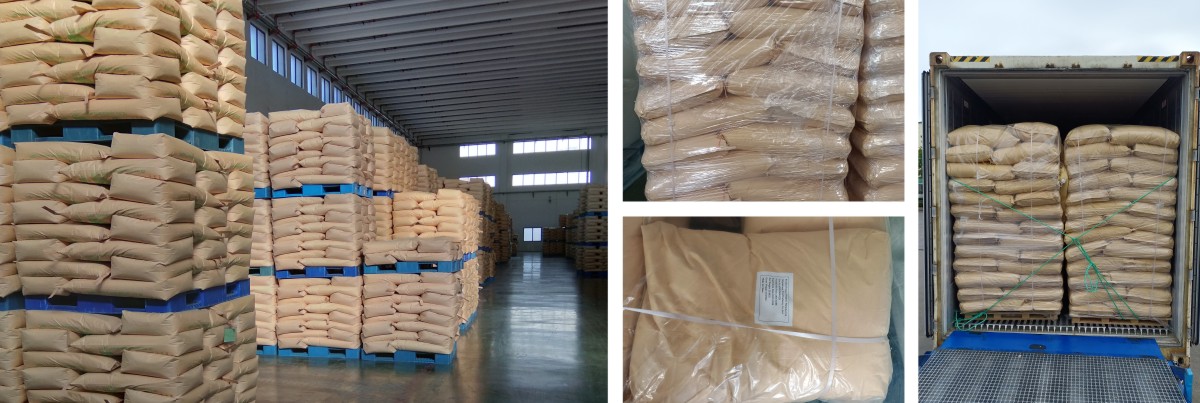
- 10 kg or 25 kg multi-wall paper bags with food-grade PE liner
- 500 kg–1,000 kg FIBCs for industrial users
- Custom packaging available upon request
FAQs
Q: Is MOS heat stable for various food processing methods?
A: Yes, MOS is generally stable under typical food processing conditions, including heat. Its structure allows it to maintain its beneficial properties in a wide range of applications, from baking to beverage pasteurization.
Q: What’s the typical shelf life and recommended storage for bulk quantities?
A: Our Mannooligosaccharides (MOS) typically have a shelf life of 24 months from the manufacturing date when stored in a cool, dry place (below 75°F / 24°C), away from direct sunlight and moisture, in its original sealed, airtight packaging.
Q: Is your MOS derived from a gluten-containing source?
A: No, our MOS is derived from the cell walls of Saccharomyces cerevisiae yeast, which is naturally gluten-free. This makes it an excellent choice for gluten-free product formulations.
Q: Can MOS be combined with probiotics in formulations?
A: Absolutely. MOS can be combined with probiotics to create synbiotic products. This combination provides both the beneficial bacteria (probiotics) and the selective fuel (prebiotic MOS) they need to thrive, leading to enhanced gut health benefits.