
What Is Polydextrose?
Polydextrose is a synthetic glucose polymer first developed by Pfizer in the 1960s and widely adopted across global food manufacturing since the 1980s. Chemically, it is a randomly cross-linked polysaccharide produced through the thermal condensation of glucose with approximately 10 percent sorbitol and 1 percent citric acid. The resulting structure contains multiple glycosidic linkages—primarily 1,6 bonds but also 1,2, 1,3, and 1,4 connections—creating a highly branched, irregular polymer that resists enzymatic digestion in the small intestine, which is why it functions as a soluble dietary fiber.
With a molecular weight averaging around 2,500 daltons and a degree of polymerization of roughly 12 glucose units, polydextrose is substantially smaller than inulin (10-60 fructose units) or resistant dextrin (15-30 glucose units), yet it provides comparable bulking capacity at a fraction of the caloric load—approximately 1 kilocalorie per gram, roughly one-quarter the energy of digestible carbohydrates.
What distinguishes polydextrose from many other fiber ingredients is its multifunctional character. It acts simultaneously as a bulking agent, a humectant, a sugar replacer, and a prebiotic fiber. A single ingredient can replace multiple functional additives, which is why formulators across the bakery, beverage, dairy, confectionery, and nutritional categories turn to it repeatedly. The neutral to faintly sweet taste profile and high solubility make it especially versatile—it dissolves clear in solution and does not compete with the intended flavor profile of the finished product.
Organic polydextrose shares the identical chemical identity as conventional polydextrose (CAS 68424-04-4) but is manufactured from certified organic glucose derived from non-GMO corn, with no synthetic catalysts at any stage—an alignment with organic food standards that matters for brands in the clean-label and certified organic segments. Our organic polydextrose products carry full organic, Non-GMO, Kosher, and Halal certifications. For detailed product specifications and ordering information, see our organic polydextrose product page.
Polydextrose Powder vs Polydextrose Syrup
Polydextrose is commercially available in two primary physical forms: a free-flowing powder and a viscous liquid syrup. Though chemically identical, the differences in physical form dictate which applications each serves best.
The powder form is a 200-300 mesh white to cream-colored powder with approximately 90 percent or higher dietary fiber content on a dry-weight basis. It pours freely, dissolves readily in water to form a clear solution, and is preferred for dry blending applications such as bakery mixes, powdered beverages, snack seasonings, and capsule-based supplements. Its low moisture content (typically under 4 percent) gives it excellent shelf stability in cool, dry conditions.
The syrup form is a 70-75 percent solids aqueous solution with an amber color and a viscosity similar to light corn syrup. It delivers approximately 70-80 percent dietary fiber on a dry-solids basis and is the preferred choice for liquid-phase applications: beverages, sauces, dairy drinks, ice cream, and confectionery syrups. Because it is already in solution, the syrup eliminates the hydration step required when using powder in liquid systems, saving processing time and energy. For product details on the liquid form, visit our organic polydextrose syrup page.
The following table provides a side-by-side comparison of the two forms across key parameters.
| Parameter | Polydextrose Powder | Polydextrose Syrup |
|---|---|---|
| Appearance | White to cream, free-flowing powder | Amber, viscous liquid |
| Solids Content | 96% minimum | 70-75% |
| Dietary Fiber (dry basis) | 90% or higher | 70-80% |
| Particle Size / Viscosity | 200-300 mesh | Approx. 2,000-5,000 cP at 25 C |
| Best Applications | Dry blends, baking, supplements, snack coatings | Beverages, sauces, dairy, confectionery, ice cream |
| Handling | Requires dust control; hygroscopic | Requires temperature-controlled storage; pumpable |
| Shelf Life | 24 months (cool, dry) | 12-18 months (sealed, ambient) |
| Hydration Step | Required for liquid systems | Not required; already in solution |
How Is Polydextrose Made?
The manufacturing pathway for polydextrose differs fundamentally from the enzymatic processes used to produce fibers like resistant dextrin or fructooligosaccharides: it is produced through thermal polymerization, a heat-driven condensation reaction that relies on neither enzymes nor fermentation.
The starting materials are three simple ingredients: glucose, sorbitol, and citric acid. Glucose serves as the primary monomer providing the polymer backbone; sorbitol, at roughly 8-12 percent of the reaction mass, acts as a plasticizer and chain terminator that controls molecular weight and prevents insoluble over-polymerization; and citric acid, at approximately 1 percent, functions as both an acid catalyst and a cross-linking agent, introducing ester bonds that contribute to the branched architecture.
These three components are blended and heated under vacuum at temperatures typically between 140 and 160 degrees Celsius. Water is eliminated and glycosidic bonds form between glucose molecules in multiple configurations, producing a randomly branched, polydisperse polymer, while the vacuum drives off water vapor and prevents oxidative discoloration.
After the reaction reaches the target degree of polymerization, the molten mass is cooled and dissolved in water, then purified through activated carbon treatment for decolorization, ion-exchange chromatography to remove ionic impurities and residual monomers, and filtration. For the powder form, the purified solution is concentrated and spray-dried; for syrup, it is concentrated to 70-75 percent solids and packaged.
In organic production, every input must meet organic certification standards: the glucose is sourced from certified organic, non-GMO corn, no synthetic catalysts, solvents, or processing aids are introduced, and full audit trail documentation accompanies each batch.
Polydextrose vs Other Common Fibers and Sweeteners
The ingredient landscape for fibers and low-calorie bulking agents includes several options that overlap with polydextrose in function but differ materially in source, structure, performance, and nutritional profile. The table below compares polydextrose against three alternatives formulators most frequently consider: resistant dextrin, inulin, and maltodextrin.
| Property | Polydextrose | Resistant Dextrin | Inulin | Maltodextrin |
|---|---|---|---|---|
| Source | Glucose (corn) + sorbitol + citric acid | Corn or tapioca starch | Chicory root or agave | Corn, potato, or tapioca starch |
| Production Method | Thermal polymerization (non-enzymatic) | Enzymatic debranching + heat | Hot-water extraction | Acid or enzymatic hydrolysis |
| Caloric Value | ~1 kcal/g | ~2 kcal/g | ~1.5 kcal/g | ~4 kcal/g |
| Dietary Fiber | 70-90%+ | 85-95% | 85-90% | 0% (fully digestible) |
| Glycemic Index | ~5 | ~10 | ~0-2 | ~85-105 |
| Solubility | High; clear solution | High; clear to slightly hazy | Moderate; may precipitate | High; clear solution |
| Sweetness | Neutral to faintly sweet | Neutral | Mildly sweet (10% of sucrose) | Mildly sweet to neutral |
| pH Stability | 2.5-7.0 | 2.0-7.0 | Below 4.0 can hydrolyze | 2.0-7.0 |
| Heat Stability | Up to ~200 C | Up to ~180 C | Degrades above ~140 C | Up to ~180 C |
| Prebiotic Effect | Yes (bifidogenic) | Yes | Yes (strong) | No |
| Regulatory Approvals | FDA, EFSA, FOSHU, GB 2760 | FDA, EFSA, FOSHU | FDA, EFSA, FOSHU | FDA, EFSA (as food ingredient) |
Resistant dextrin and polydextrose are often confused because both are glucose-derived, water-soluble fibers with low glycemic impact, but their production pathways are fundamentally different: resistant dextrin relies on enzymatic treatment of starch followed by heat-induced rearrangement, whereas polydextrose is a purely thermal condensation product. In practice, polydextrose typically costs less per kilogram of fiber delivered, dissolves with greater clarity, and provides superior humectancy.
Inulin is the most potent prebiotic in this group, but it has lower solubility in cold water, can precipitate at high concentrations, and hydrolyzes into fructose below pH 4.0, limiting its use in acidic beverages. Polydextrose remains stable between pH 2.5 and 7.0, making it suitable for formulations that inulin cannot tolerate.
Maltodextrin is not a fiber at all—it is a fully digestible carbohydrate delivering 4 kilocalories per gram with a glycemic impact comparable to glucose. It serves as a bulking agent and carrier but offers none of the fiber-related nutritional benefits polydextrose provides.
Key Functional Properties
The value of polydextrose in food formulation stems from its combination of functional properties, not from any single attribute; formulators who understand the full range find ways to simplify ingredient lists and reduce costs.
Low Caloric Density. At approximately 1 kilocalorie per gram, polydextrose provides roughly 75 percent fewer calories than sugar—a value established through metabolic studies demonstrating limited small-intestinal absorption and partial colonic fermentation. Replacing 50 grams of sugar in a formulation, switching to polydextrose saves roughly 150 kilocalories per serving. For more on the nutritional science, read our companion article on polydextrose and inflammation.
Bulking and Body. When sugar is removed from a formulation, a physical void remains—bulk that must be replaced or the product collapses in texture, mouthfeel, or appearance. Polydextrose’s molecular weight and water-binding capacity restore the body lost when sugar or fat is reduced, matching the mouthfeel of the ingredients it replaces.
Humectancy. Polydextrose is strongly hygroscopic, attracting and retaining moisture—a property particularly valuable in baked goods, cereal bars, and intermediate-moisture foods where preventing staling is critical. Unlike glycerol, which can impart an off-taste at high inclusion rates, polydextrose contributes humectancy without flavor interference.
Solubility and Clarity. Polydextrose dissolves completely in water to form a clear solution at concentrations up to 80 percent weight by weight, so beverages formulated with it will not cloud, settle, or develop sediment during storage. Solution viscosity remains manageable, allowing high fiber loads without creating syrupy or gummy textures.
pH and Heat Stability. Polydextrose remains stable across pH 2.5 to 7.0, covering virtually every food category from acidic fruit beverages to neutral dairy systems, and withstands thermal processing up to approximately 200 degrees Celsius—surviving baking, retorting, UHT treatment, and extrusion without meaningful degradation. This thermal resilience is an important distinction from inulin and some other fibers that break down under severe heat.
Non-Cariogenic and Low Glycemic. Polydextrose does not promote tooth decay because oral bacteria cannot metabolize it efficiently, and its glycemic index of approximately 5 suits products marketed to consumers managing blood glucose levels.
Why Choose Organic Polydextrose?
As consumer awareness of ingredient sourcing grows, the distinction between conventional and certified organic polydextrose carries increasing commercial weight: the chemical polymer is identical, but the path from raw material to finished ingredient tells a different story.
Organic certification imposes requirements that extend from field to factory. The glucose feedstock must come from non-GMO corn grown without synthetic pesticides or fertilizers on land that has completed the multi-year transition period, with identity preservation maintained throughout the supply chain. During manufacturing, no synthetic catalysts, bleaching agents, or chemical modifiers are permitted, and all processing aids must be on the approved substances list of the relevant organic standard.
For food brands, sourcing organic polydextrose supports organic label claims on finished products. In markets where organic certification drives consumer trust and price premium—particularly North America, Western Europe, and parts of Asia-Pacific—an organic-grade functional fiber can be the difference between qualifying for an organic claim and being excluded. Organic sourcing also provides the audit trail many corporate buyers now require in supplier qualification programs.
Brands formulating with organic polydextrose from BIOSTARCH benefit from a vertically coordinated supply chain with documented traceability, and the combination of organic, Non-GMO, Kosher, and Halal compliance means a single ingredient satisfies multiple label requirements simultaneously.
Common Applications at a Glance
The table below summarizes the most common application categories for polydextrose and the primary functional roles polydextrose serves in each.
| Application Category | Product Examples | Primary Function of Polydextrose |
|---|---|---|
| Bakery | Cookies, cakes, breads, muffins | Sugar reduction, bulking, humectancy, crumb softening |
| Beverages | RTD teas, protein shakes, flavored waters | Fiber enrichment, body, sugar replacement |
| Dairy & Frozen Desserts | Yogurt, ice cream, dairy drinks | Bulking, texture, freeze-thaw stability, sugar reduction |
| Confectionery | Hard candies, gummies, chocolate | Sugar-free bulking, non-cariogenic sweetness carrier |
| Nutritional Bars | Protein bars, meal replacement bars | Humectancy, binding, fiber enrichment |
| Sauces & Dressings | Ketchup, salad dressings, marinades | Body and mouthfeel, sugar replacement, water binding |
| Dietary Supplements | Fiber capsules, powdered drink mixes | Prebiotic fiber delivery, excipient |
| Meat & Savory | Sausages, patties, plant-based meats | Water binding, texture, fat replacement |
For a practical look at how polydextrose enables better-for-you formulations in consumer products, see our article on polydextrose in everyday foods.
Specifications and Quality Standards
For procurement and quality assurance professionals, the typical specification profile of organic polydextrose is essential for incoming material acceptance and formulation consistency. The table below presents the standard specifications for organic polydextrose powder, the most commonly traded form.
| Parameter | Specification | Test Method |
|---|---|---|
| Appearance | White to cream, free-flowing powder | Visual |
| Dietary Fiber (dry basis) | 90% minimum | AOAC 2011.25 / GB 5009.88 |
| Moisture | 4.0% maximum | Karl Fischer / Oven drying |
| pH (10% solution) | 2.5-7.0 | pH meter |
| Ash (sulfated) | 0.3% maximum | GB 5009.4 |
| Glucose (free) | 4.0% maximum | HPLC |
| Sorbitol (free) | 2.0% maximum | HPLC |
| 5-Hydroxymethylfurfural (5-HMF) | 0.1% maximum | HPLC |
| Lead (Pb) | 0.5 mg/kg maximum | ICP-MS / AAS |
| Arsenic (As) | 0.3 mg/kg maximum | ICP-MS / AAS |
| Total Plate Count | 1,000 CFU/g maximum | GB 4789.2 |
| Coliforms | Negative in 1 g | GB 4789.3 |
| Mesh Size | 200-300 mesh (74-48 micron) | Sieve analysis |
These specifications align with the requirements of FDA 21 CFR 172.841 in the United States, EFSA standards in the European Union, Japan’s FOSHU framework, and China’s GB 2760. Organic polydextrose must additionally meet the applicable organic standard (NOP, EU Organic, or GB/T 19630), including documentation of feedstock origin, production audit trail, and segregation from conventional material.
About Our Organic Polydextrose
BIOSTARCH offers certified organic polydextrose in both powder and syrup forms, manufactured from non-GMO corn glucose under full organic certification. Our polydextrose meets the functional specifications detailed throughout this guide and carries Non-GMO, Kosher, and Halal certifications in addition to its organic credentials. For technical data sheets, samples, or formulation support, contact our applications team.
Recommended Products
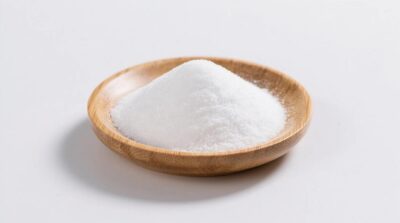
Polydextrose Powder
Polydextrose powder is a non-GMO soluble fiber with ≥90% total dietary fiber (dry basis)…
Fructooligosaccharides
Fructooligosaccharides (FOS) is a prebiotic fiber at 95% purity from non-GMO sugarcane or chicory.…
Organic Resistant Dextrin
Organic resistant dextrin is a certified-organic soluble dietary fiber (≥90% dry basis) from non-GMO…


