
Procuring organic resistant dextrin at commercial scale requires more than comparing quoted prices. Sourcing errors show up not in the invoice but in rejected batches, failed label claims, and delayed product launches. This guide covers every critical decision point: quality grades, COA interpretation, supplier evaluation, certification verification, and cost structure.
Organic vs Conventional Resistant Dextrin
Organic resistant dextrin differs from conventional at every supply chain stage. The starch feedstock — typically tapioca or corn — must be grown without synthetic pesticides, herbicides, or prohibited fertilizers, and must come from non-GMO seed stock. The dextrinization process must comply with organic processing standards: heat-based and enzymatic methods are accepted by organic certifiers, whereas acid-catalyzed pyrolysis using synthetic catalysts is not permitted under USDA National Organic Program or EU organic regulations.
The price premium for organic over conventional grades typically ranges from 15% to 30%. This premium is justified by clean-label positioning, consumer demand for certified organic ingredients, and the regulatory clarity that comes with formal certification. Three certification frameworks are available: USDA Organic, EU Organic, and China Organic. Each has distinct documentation requirements, and some markets require dual certification.
For formulators already working with organic prebiotics, the compliance pathway for resistant dextrin follows a familiar pattern. Additional context on organic processing standards as they apply to soluble fibers is available in our guide to organic resistant dextrin powder specifications.
Quality Grades and Specifications
Resistant dextrin is commercially available in two primary quality grades. Food grade, with a minimum dietary fiber content of 85%, is the standard for most applications — beverages, baked goods, dairy products, and conventional supplements. High-purity grade, at 90% dietary fiber or above, serves premium supplement formulations, medical nutrition products, and applications where maximizing fiber per serving is critical to label claims.
Beyond fiber content, several specifications define material quality. DE (dextrose equivalent) value should be below 5, confirming that the product is genuinely resistant rather than partially hydrolyzed. Moisture content must remain below 5% for powder forms. Ash content below 0.5% indicates adequate purification. The pH range of 4.0–6.0 is standard. Heavy metals must meet applicable limits under GB, EU, or USP standards. Microbial limits are equally important: total plate count below 10,000 CFU/g, yeast and mold below 100 CFU/g, and negative results for coliforms, Salmonella, and other pathogens.
The table below summarizes key specifications across the two commercial grades:
| Parameter | Food Grade | High-Purity Grade |
|---|---|---|
| Dietary Fiber (AOAC 2009.01/2011.25) | ≥85% | ≥90% |
| DE Value | <5 | <5 |
| Moisture (powder) | <5% | <5% |
| Ash | <0.5% | <0.3% |
| pH (10% solution) | 4.0–6.0 | 4.0–6.0 |
| Heavy Metals (Pb, As, Cd, Hg) | Per GB/EU/USP | Per GB/EU/USP |
| Total Plate Count | <10,000 CFU/g | <10,000 CFU/g |
| Yeast/Mold | <100 CFU/g | <100 CFU/g |
| Pathogens (Salmonella, E. coli) | Negative | Negative |
| Particle Size | 100–200 mesh | 100–200 mesh |
| Color | White to off-white | White to off-white |
How to Read a Resistant Dextrin COA
A Certificate of Analysis is the primary document for verifying that a specific batch meets agreed-upon specifications. Reading it correctly — and knowing what each parameter reveals about production quality — is essential for procurement professionals.
Dietary Fiber Content is the headline figure. For standard food-grade material, the COA should show 85% or higher measured by AOAC 2009.01 or 2011.25. Values below this threshold indicate either incomplete dextrinization or blending with non-resistant carbohydrate material. Always confirm the test method, as older methods may overestimate fiber content.
DE Value confirms resistance. A value below 5 indicates that the product has undergone sufficient molecular rearrangement during dextrinization to resist digestion. Higher DE values suggest incomplete conversion, meaning the material will behave more like maltodextrin than resistant dextrin in the gut.
Moisture must be below 5% for powder. Resistant dextrin is hygroscopic — elevated moisture on arrival usually indicates poor storage, inadequate packaging, or excessive humidity during transit. This is a practical red flag that the supply chain may not be handling the material correctly.
Ash below 0.5% confirms adequate purification. Higher ash values suggest that mineral residues from the starch source or processing aids were not fully removed, which can affect taste clarity and regulatory compliance.
Heavy Metals — lead, arsenic, cadmium, and mercury — should each be listed with measured values and compared against applicable limits (GB 2762 for China, EU Commission Regulation for Europe, USP <232>/<233> for the United States). Starch sourced from certain agricultural regions may carry elevated heavy metal profiles, so this parameter warrants particular attention.
Microbial Results — total plate count, yeast/mold, coliforms, and pathogen screens — verify that the product is safe for food use. Any positive pathogen result is an immediate rejection criterion.
Particle Size matters for application performance. If your product is a clear beverage, you need fine particle material (typically 100–200 mesh) that dissolves without visible sediment. For cereal bars or baked goods, coarser material may be acceptable. Request a full particle size distribution (PSD) report if your application is sensitive to dissolution rate or flow properties.
Color should be white to off-white powder. A yellowish tint suggests excessive thermal input during production, which can degrade the resistant fraction and produce off-flavors.
For a deeper look at how these specifications translate into functional performance in finished products, see our article on resistant dextrin powder applications and formulation.
Supplier Evaluation Checklist
Selecting a resistant dextrin supplier requires evaluating both documented credentials and operational capabilities. The following checklist covers the critical assessment areas:
Raw Material Traceability — Can the supplier trace starch feedstock back to a specific farm, cooperative, or region? Traceability is especially important for organic material, where the integrity of the certification depends on the entire supply chain, not just the final processing step.
Organic Certification Validity — Do not accept a supplier’s claim at face value. Request the current organic certificate, verify it with the certifying body, and check the expiration date. Certificates that have lapsed or are pending renewal represent a compliance risk.
Production Capacity and Lead Times — Understand the supplier’s actual production volume, not just theoretical capacity. Ask about current order commitments and typical lead times.
Batch-to-Batch Consistency — Request COAs from at least three recent production batches and compare the key parameters. Wide variation in fiber content, moisture, or DE value across batches signals inconsistent process control.
Third-Party Testing — Does the supplier use independent laboratories for analytical testing, or do they rely solely on in-house results? Independent verification adds credibility, particularly for dietary fiber content and heavy metals.
Packaging Options — Standard packaging is 25 kg multi-wall paper bags with PE liner. Premium grades may come in 20 kg packaging. For hygroscopic powders, packaging integrity directly affects shelf life.
Documentation Package — A complete package includes: COA, organic certificate, Non-GMO certificate, Kosher and Halal certifications, MSDS/SDS, product specification sheet, and manufacturing flow chart. Any gaps in this package should be addressed before committing to an order.
Audit Readiness — Suppliers holding FSSC 22000 or ISO 22000 certification demonstrate a structured food safety management system. These certifications are increasingly required by major retailers and food manufacturers.
Resistant Dextrin Supply Chain and Production Regions
Production of resistant dextrin is concentrated in Asia, with China, Japan, and increasingly India and Southeast Asia as the primary manufacturing regions. China dominates global volume, producing both tapioca-based resistant dextrin (using starch sourced from Guangxi province and Thailand) and corn-based material (using starch from North China’s corn belt). Taiwan and Japan pioneered the technology — Matsutani Chemical Industry’s Fibersol-2 brand established the resistant dextrin category and remains a recognized reference point for quality.
Organic supply is narrower than conventional. Fewer certified organic starch sources exist, and the dextrinization facilities themselves must maintain organic segregation protocols. This concentration means that lead times for organic resistant dextrin are typically longer: 4–8 weeks for organic material compared to 2–4 weeks for conventional. Minimum order quantities also reflect this difference — sample orders of 100–500 kg are typical for organic, while commercial orders generally start at 1–5 metric tons.
When evaluating suppliers in these regions, consider logistical factors beyond price: port proximity, export documentation capability, and experience shipping to your target market.
Cost Factors and Pricing
The price of organic resistant dextrin reflects several cost components that procurement teams should understand individually:
Raw Material Cost — Organic starch feedstock (tapioca or corn) carries a premium over conventional starch. Tapioca-based dextrin typically commands a slightly higher price than corn-based due to starch sourcing costs and lower processing volumes.
Processing Complexity — Dextrinization is energy-intensive, involving controlled thermal treatment. Energy costs represent a significant portion of production cost, and suppliers in regions with higher energy prices will reflect this in quotations.
Purification Costs — Achieving fiber content above 85% requires effective purification to remove non-resistant fractions. Higher purity grades require additional processing steps, reflected in the price differential.
Certification Costs — Organic certification, Non-GMO verification, Kosher and Halal certification, and food safety management system registration each carry annual fees and audit costs that suppliers pass through to pricing.
Logistics — International freight, insurance, customs clearance, and inland transportation add to the delivered cost. These costs vary significantly by destination.
In terms of relative positioning among soluble fibers, resistant dextrin trades at a moderate price point — typically more expensive than inulin per kilogram but less expensive than specialized prebiotics like XOS or GOS. However, the cost comparison that matters is price per gram of effective fiber delivered. Because resistant dextrin can be used at higher doses without gastrointestinal discomfort (up to 45–50 g/day compared to 5–10 g/day for inulin in sensitive populations), the ingredient cost per serving for a fiber claim can actually be lower.
| Prebiotic Fiber | Relative Price (per kg) | Typical Max Tolerance | Effective Cost per Fiber Claim |
|---|---|---|---|
| Resistant Dextrin | Moderate | 45–50 g/day | Low (high serving = low cost per claim) |
| Inulin | Low | 5–15 g/day | Moderate (GI tolerance limits dose) |
| FOS | Moderate–High | 10–15 g/day | Moderate–High |
| Polydextrose | Low–Moderate | 45–50 g/day | Low |
| Acacia Fiber | Moderate | 20–30 g/day | Moderate |
Certifications and Documentation
The certification landscape for organic resistant dextrin includes both organic-specific and general food industry credentials:
Organic Certifications — USDA Organic, EU Organic, and China Organic each require separate certification processes, though some audits may overlap. Verify that the organic certificate covers the specific product (resistant dextrin) and the specific facility, not just the broader operation.
Non-GMO Project Verified — While organic certification inherently requires non-GMO feedstock, the Non-GMO Project Verified mark provides additional consumer recognition and may be required by certain retail channels.
Kosher and Halal — Kosher certification from recognized agencies such as OU or Star-K and Halal certification from MUI or JAKIM are standard requirements for multi-market products. Confirm that the certification covers the specific product form (powder, syrup).
Food Safety Management — FSSC 22000 and ISO 22000 are the primary food safety management system certifications. BRC and SQF certifications may be required by specific retailers.
Pharmaceutical and Nutraceutical — For products targeting pharmaceutical or medical nutrition applications, cGMP compliance is essential. USP or EP monograph compliance, where applicable, provides additional quality assurance.
Always request current certificates — not copies of expired documents — and verify renewal dates. Confirm that the certifying body is recognized in your target market, as some regional certifications may not be accepted internationally.
For more on how these certifications relate to the functional properties and health claims associated with resistant dextrin, see our overview of resistant dextrin health benefits and regulatory positioning.
Common Sourcing Pitfalls and How to Avoid Them
Confusing resistant dextrin with maltodextrin — These are fundamentally different ingredients. Maltodextrin has a DE of 3–20 and is rapidly digestible; resistant dextrin has a DE below 5 and resists digestion. Check the DE value on the COA and the product specification sheet. If a supplier cannot clearly distinguish the two, find a different supplier.
Buying conventional material labeled as “natural” — The term “natural” has no standardized regulatory definition in most markets and does not equate to certified organic. If you need organic resistant dextrin, verify the organic certification — not just a “natural” claim on the specification sheet.
Assuming all resistant dextrins have the same fiber content — Commercial products range from approximately 80% to over 90% dietary fiber. A product at 80% fiber delivers measurably less functional fiber per kilogram than one at 90%. Always specify a minimum fiber content in your purchase specifications rather than accepting a range.
Ignoring particle size — Particle size affects dissolution rate, flow properties, and mouthfeel. Fine powder (100–200 mesh) is essential for clear beverages where rapid dissolution without sediment is required. Coarser material may be acceptable for bars but will cause problems in drinks. Request PSD data before committing.
Not testing for heavy metals from the starch source — Starch feedstock can carry heavy metal residues from soil and agricultural inputs. Request heavy metal test results per batch, and pay particular attention to lead and arsenic if the starch is sourced from regions with known soil contamination concerns.
Moisture issues from poor packaging — Resistant dextrin is hygroscopic and will absorb moisture if packaging is inadequate. Avoid oversized bags (35 kg bags are too large for hygroscopic material — they remain open longer during use). Prefer 20–25 kg multi-wall paper bags with intact PE liners. Check that packaging seals are intact on arrival and that the supplier uses moisture-barrier materials suitable for your climate and storage conditions.
About Our Organic Resistant Dextrin
Our organic resistant dextrin is produced from traceable, certified organic tapioca starch under FSSC 22000-certified conditions, with full organic, Non-GMO, Kosher, and Halal certification packages available for every shipment. Each batch ships with a complete Certificate of Analysis confirming dietary fiber content, DE value, heavy metals, and microbial results — ensuring batch-to-batch consistency and regulatory compliance across global markets.
Recommended Products
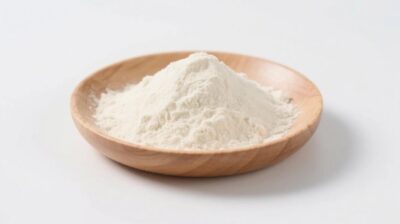
Organic Resistant Dextrin
Organic resistant dextrin is a certified-organic soluble dietary fiber (≥90% dry basis) from non-GMO…


